

As India’s micro, small, and medium enterprises continue to drive innovation and job creation, access to finance remains one of the sector’s most critical challenges. For decades, small business owners without tangible assets have struggled to secure bank loans due to strict collateral requirements. Recognizing this, the government has strengthened its credit guarantee framework, offering MSMEs the ability to access collateral-free loans under the 2026 Credit Guarantee Scheme. This initiative aims to empower small enterprises to grow, modernize operations, and compete in an increasingly digital economy.
At the heart of this program is the Credit Guarantee Fund Trust for Micro and Small Enterprises, a government-backed body established to help banks and lending institutions extend loans without demanding traditional collateral or third-party guarantees. The scheme provides a guarantee cover, reducing risk for lenders and enabling MSMEs to access working capital and term loans that were previously out of reach. Under the latest guidelines, collateral-free loans now extend to significantly larger amounts, allowing enterprises to finance expansion, technology upgrades, and other business-critical investments.
The 2026 enhancements to the credit guarantee framework go beyond simple loan coverage. A Mutual Credit Guarantee Scheme has been introduced, specifically targeting MSME manufacturing units, allowing loans for plant, machinery, and equipment acquisition with guarantee coverage for even larger amounts. Startups and exporter-focused MSMEs also benefit from higher credit limits, reflecting a push to encourage entrepreneurship and international trade. Additionally, some regional programs collaborate with the central government to provide more generous guarantee coverage, sometimes up to 95 percent of the loan value, for eligible enterprises in priority sectors.
Collateral-free loans are transformative for MSMEs, particularly for those operating in services, technology, and other asset-light sectors. Many small business owners, including women entrepreneurs and first-generation founders, have historically faced significant barriers to formal financing because they lacked physical assets. By enabling banks to lend based on business viability and cash flow rather than collateral, the scheme opens doors to a more inclusive and forward-looking credit ecosystem.
Eligibility for these loans typically includes micro and small enterprises engaged in manufacturing, services, or trade. Businesses must have valid registrations, such as Udyam registration, and demonstrate financial stability. Both new and existing units can apply, provided they are in good standing with financial institutions. Special provisions also exist to support women-led businesses and other priority categories.
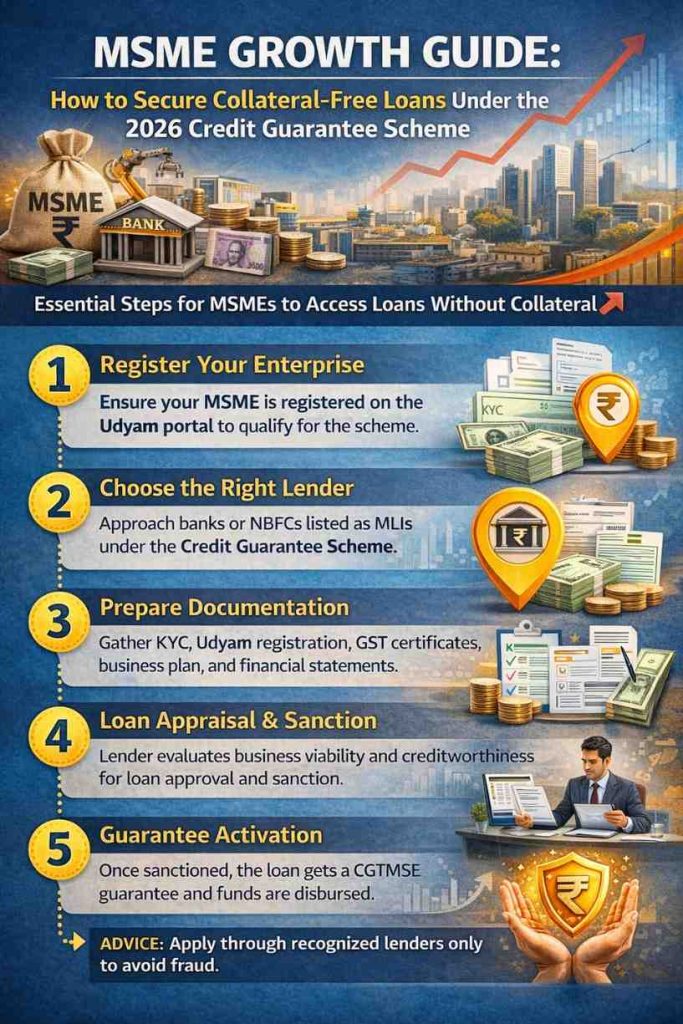
While collateral-free loans simplify access to credit, securing one still requires preparation and diligence. Business owners are advised to complete proper registration, approach recognized lenders under the scheme, and prepare thorough documentation, including KYC records, financial statements, bank statements, and a business plan or project report. Lenders conduct a credit appraisal to evaluate repayment capacity and business viability. Once approved, the government-backed guarantee is activated, and funds are disbursed to the enterprise.
Despite these advancements, challenges remain. Lenders continue to evaluate credit quality and repayment capability, and enterprises must navigate documentation and compliance requirements carefully. Fraudulent schemes have occasionally targeted unsuspecting businesses, underscoring the importance of applying through legitimate financial institutions.
The expanded credit guarantee framework represents a pivotal shift in India’s approach to MSME finance. By reducing dependency on collateral and broadening access to credit, the government aims to nurture a more resilient and competitive MSME sector. For entrepreneurs across the country, understanding and leveraging collateral-free loans under the 2026 scheme is not just a pathway to growth; it is a step toward fostering innovation, creating employment, and contributing to India’s emergence as a global hub for small business excellence.
Add startupupdates.in as preferred source on google – Click Here
Last Updated on Friday, January 30, 2026 3:50 pm by Startup Updates Team
About Author


