

As India’s startup ecosystem matures beyond metro hubs and marquee venture capital firms, founders are increasingly exploring alternative routes to raise early-stage capital. Among these, equity crowdfunding has emerged as a compelling, though often misunderstood, option. Globally, equity crowdfunding allows startups to raise funds from a large pool of investors in exchange for ownership. In India, however, the model has evolved in a distinctly different way, shaped by regulatory realities and market innovation.
Unlike the US or the UK, India does not yet permit open, retail-facing equity crowdfunding in the purest sense. Securities laws classify public solicitation of equity as a regulated activity, requiring compliance akin to a public issue. As a result, most Indian platforms operate through private placement structures, curated investor networks, or community-based equity models. For founders, this makes understanding the landscape critical before choosing a platform or launching a raise.
Several platforms have nonetheless built compliant frameworks that give startups access to a broad investor base while staying within the bounds of Indian law. These platforms do not just facilitate capital; they shape investor perception, governance standards, and long-term cap table health. For founders considering this route, knowing how each platform functions and what it expects is as important as the capital itself.
Let’sVenture is often regarded as one of the earliest movers in India’s equity crowdfunding-adjacent space. Rather than opening fundraising to the general public, it connects startups with accredited investors, angel networks, and micro-VCs through a structured digital marketplace. Founders typically go through a screening process, after which their pitch is showcased to a network of experienced investors. This model suits startups at the pre-seed and seed stages that are looking for strategic investors alongside capital. However, founders should be prepared for detailed due diligence and clear articulation of their growth roadmap, as investor expectations on the platform are relatively sophisticated.
Grex takes a slightly different approach by functioning as a private placement exchange. It enables founders to list fundraising opportunities that are then accessed by a closed group of investors and facilitators. The platform focuses on deal discovery and transaction facilitation rather than heavy curation. For founders who already have some traction and clarity on valuation, Grex can offer flexibility. That said, the onus of storytelling, investor follow-up, and compliance readiness rests largely on the startup itself, making preparation essential.
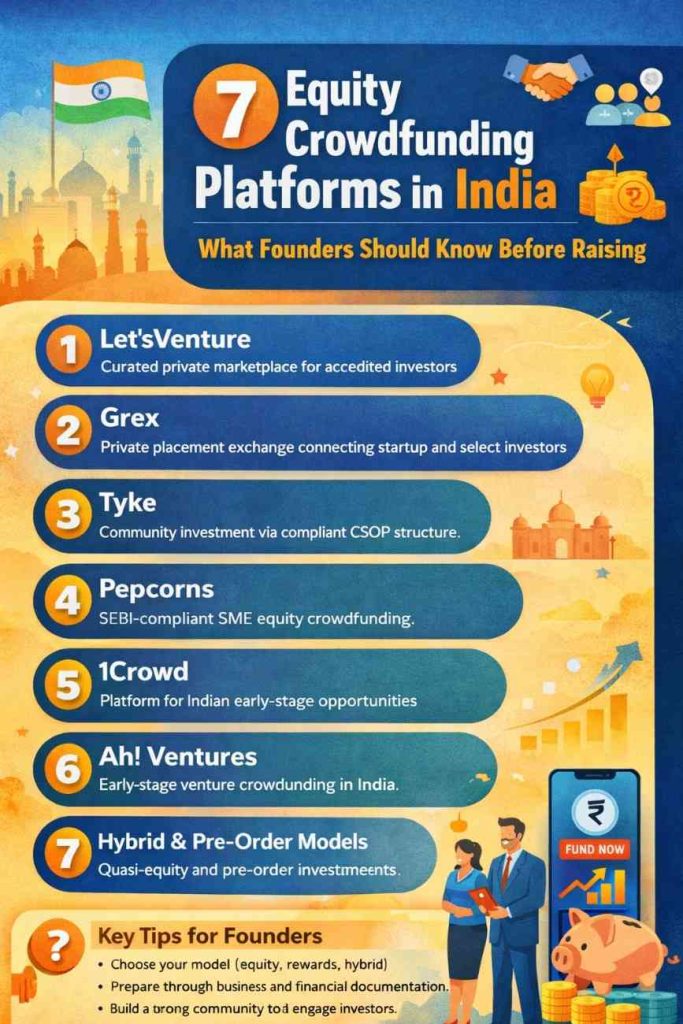
Tyke represents a newer wave of platforms attempting to democratize startup investing while navigating regulatory constraints. It uses structured instruments such as community stock options or similar mechanisms to allow founders to bring customers, supporters, and early believers onto their cap table. This model appeals to consumer-facing startups with strong brand loyalty or active communities. For founders, Tyke offers the advantage of turning users into stakeholders, but it also requires careful planning around governance, disclosures, and long-term investor communication.
Pepcorns stands out for its focus on small and medium enterprises rather than purely venture-scale startups. Positioned as a compliant equity platform for growth-oriented businesses, it enables SMEs to raise capital from a mix of investors through transparent processes. Founders with steady revenues, proven business models, and clear expansion plans tend to benefit most from this route. However, equity raised at this stage often comes with expectations of profitability and disciplined execution, which may not suit very early-stage or experimental ventures.
1Crowd operates as an India-centric platform designed to connect startups with investors seeking early-stage opportunities. It emphasizes long-term value creation and community engagement rather than rapid fundraising alone. For founders, this can mean access to investors who are patient and aligned with the startup’s mission. At the same time, managing multiple small investors requires strong communication practices and clarity on shareholder rights, which founders must be ready to handle.
Ah! Ventures has built its presence around early-stage venture investing with a crowdfunding-like approach. By offering startups visibility to a wide investor base, it aims to bridge the gap between angel funding and institutional capital. Founders using such platforms often benefit from increased exposure within the startup ecosystem, but they must also be mindful of valuation discipline and future fundraising implications, as early equity decisions can shape later rounds.
Beyond these platforms, several hybrid models exist in India that blend elements of reward-based crowdfunding, pre-orders, and community participation with future equity opportunities. While not direct equity crowdfunding platforms, they often act as stepping stones, allowing founders to validate demand, build momentum, and prepare for formal equity raises. For some startups, especially in hardware or consumer products, this staged approach reduces risk and strengthens the eventual investment narrative.
For founders, the most important reality to grasp is that equity crowdfunding in India is not just about raising money online. It is about navigating compliance, managing a diverse investor base, and aligning fundraising strategy with long-term growth plans. Private placement limits, disclosure requirements, and shareholder management are not optional considerations; they are central to the process.
Equally critical is the understanding that crowdfunding success depends heavily on trust and storytelling. Unlike traditional VC fundraising, where a handful of investors make decisions behind closed doors, these platforms often expose startups to a wider audience. A clear vision, transparent financials, and credible execution plans can significantly influence outcomes.
As regulatory frameworks continue to evolve, equity crowdfunding in India is likely to become more structured and possibly more open over time. Until then, founders must approach it with clarity, caution, and preparation. Used thoughtfully, these platforms can offer not just capital, but community, credibility, and a powerful launchpad for sustainable growth.
Add startupupdates.in as preferred source on google – Click Here
Last Updated on Monday, February 2, 2026 2:42 pm by Startup Updates Team
About Author


