


As global businesses reassess their software spending amid tightening budgets and tool overload, a new pattern is emerging across the SaaS industry: subscription fatigue. Enterprises that once accumulated dozens of software subscriptions to power sales, HR, finance, support, and operations are now consolidating vendors and demanding clearer returns on every recurring bill. In response, Indian SaaS companies are reshaping their product strategies around vertical AI — industry-specific artificial intelligence embedded directly into domain workflows — to increase customer retention and deliver measurable operational value.
Subscription fatigue is not a theoretical concern. Over the past several years, enterprises worldwide have expanded their SaaS stacks rapidly, often leading to overlapping capabilities, underused licenses, and integration challenges. CIO surveys and industry research have consistently shown that software rationalization has become a priority, with procurement teams asking vendors to justify renewals based on productivity gains, automation impact, and revenue contribution rather than feature lists. This shift has put pressure on horizontal SaaS platforms that offer broad, general-purpose functionality but require heavy customization before delivering industry-specific outcomes.
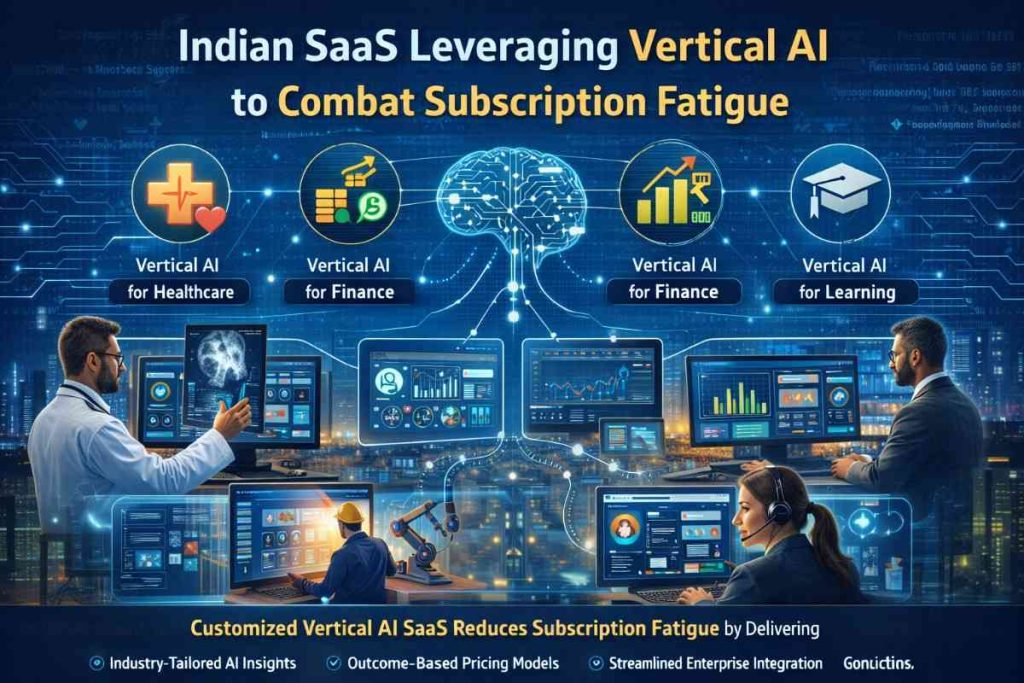
Indian SaaS firms, many of which built their global presence by serving international customers from day one, are now responding with vertical AI models that are trained, tuned, and deployed for specific sectors such as financial services, healthcare, education, retail, logistics, and manufacturing. Instead of positioning AI as a generic assistant layer, these companies are embedding intelligence directly into sector workflows — from underwriting and compliance checks to patient engagement, workforce learning, and customer support resolution. The result is software that aligns more closely with how particular industries actually operate, reducing adoption friction and improving perceived value.
Industry analysts describe vertical AI as the convergence of vertical SaaS and applied artificial intelligence. Vertical SaaS itself is not new; it refers to software designed for a specific industry rather than a broad cross-sector audience. What is new is the depth of automation and decision support made possible by recent advances in machine learning and generative AI. Indian SaaS providers are increasingly using AI to automate domain tasks, interpret sector-specific data, and generate contextual outputs that previously required human specialists. This domain alignment makes the software harder to replace and easier to justify as a continuing subscription.
Several Indian SaaS companies have publicly highlighted verticalization and AI augmentation as core product directions. Customer engagement, CRM, learning management, digital adoption, and fintech workflow platforms from India have rolled out AI-driven features tailored to the vocabulary and compliance requirements of their target sectors. In workforce learning platforms, for example, AI engines are being used to map employee skills, recommend role-specific training paths, and generate customized learning content at scale. In sales and customer engagement software, AI models are increasingly tuned for sector-specific lead scoring, conversation analysis, and funnel optimization rather than generic pipeline tracking.
This vertical AI push is also reshaping pricing and packaging. Traditional per-seat SaaS pricing is gradually being supplemented by usage-based and outcome-aligned models, particularly where AI automation replaces manual labor. Vendors are experimenting with charging based on transactions processed, cases resolved, learning outcomes achieved, or workflows automated. Such models directly address subscription fatigue by linking cost to business impact, a connection procurement leaders increasingly demand. Indian SaaS companies, known for pricing flexibility in global markets, are among the more active adopters of these hybrid pricing approaches.
Another driver behind the shift is implementation speed. One of the major causes of SaaS churn is slow time-to-value — when customers take months to configure and integrate a platform before seeing results. Vertical AI reduces this delay by shipping with pre-built industry templates, trained models, and workflow automations. Instead of starting from a blank dashboard, customers begin with sector-ready processes that can be refined rather than constructed. This faster activation improves adoption metrics and strengthens renewal probabilities.
India’s SaaS ecosystem is structurally positioned to pursue this path. The country hosts a large base of domain engineers, implementation specialists, and data professionals with experience across global industries. Over the past decade, Indian SaaS exports have expanded significantly, with companies serving North American, European, Middle Eastern, and Asia-Pacific customers across niche categories. That exposure to varied regulatory and operational environments has created the domain datasets and feedback loops needed to train vertical AI systems effectively. Founders and product leaders frequently cite customer workflow depth, not just feature breadth, as their competitive advantage.
At the same time, enterprises remain cautious about AI adoption at scale. Many organizations continue to run controlled pilots before fully deploying AI-driven systems in core workflows. Concerns around data governance, model accuracy, auditability, and regulatory compliance remain central, particularly in sectors such as finance and healthcare. Indian SaaS companies pursuing vertical AI are therefore investing heavily in explainability, human-in-the-loop controls, and compliance features to ensure their AI layers meet enterprise risk standards. Trust, not just intelligence, is becoming a selling point.
Market observers note that consolidation pressures are likely to continue across the SaaS sector over the next few years. Customers are expected to prefer platforms that can solve deeper, industry-specific problems rather than add another generic dashboard to an already crowded stack. Vertical AI strengthens vendor positioning in such an environment by embedding software more tightly into revenue-generating or compliance-critical processes. When a tool directly influences approvals, conversions, certifications, or claims outcomes, it is less vulnerable to budget cuts.
For Indian SaaS companies, the move toward vertical AI represents both a defensive and offensive strategy. Defensively, it helps reduce churn and counters subscription fatigue by increasing product indispensability. Offensively, it opens doors to higher-value enterprise deals where domain intelligence is a differentiator. As global buyers become more selective about the software they retain, the vendors that combine sector depth with AI-driven automation are likely to hold an advantage.
The broader shift suggests that the next phase of SaaS competition will be defined less by how many features a platform offers and more by how intelligently it performs within a specific industry context. Indian SaaS firms, long known for engineering scale and customer support reach, are now positioning vertical AI as the lever that keeps their subscriptions not just active, but essential.
Add startupupdates.in as preferred source on google – Click Here
Last Updated on Wednesday, February 4, 2026 8:02 pm by Startup Updates Team
About Author


