

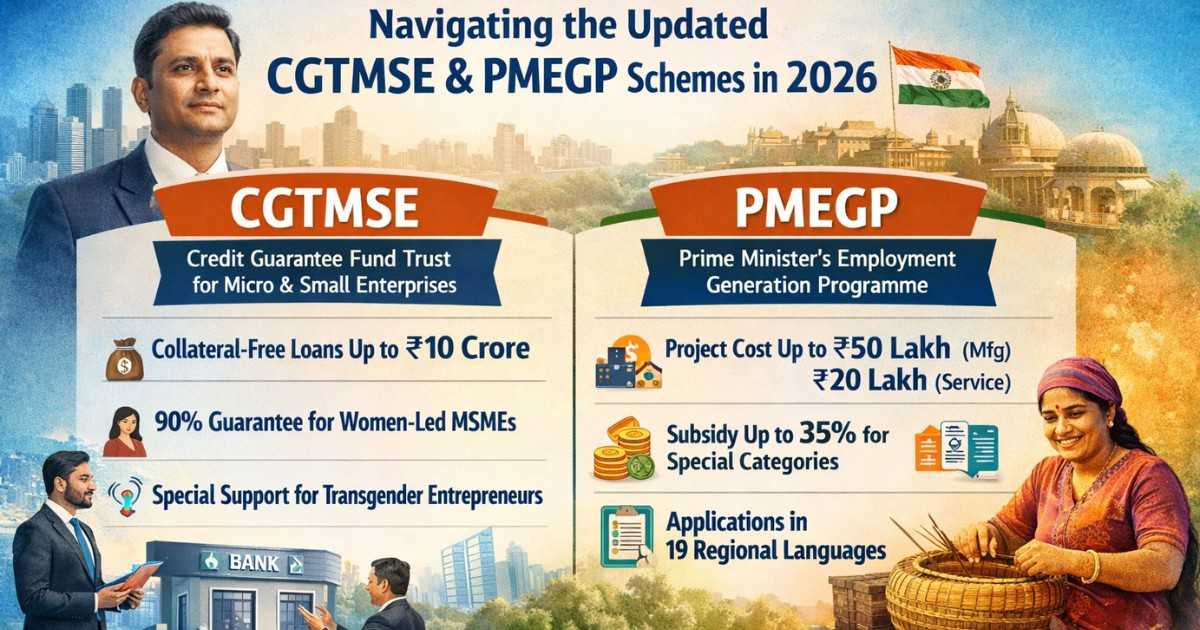
As India steps into 2026, Micro, Small, and Medium Enterprises continue to occupy a central role in the nation’s economic development. With millions of small businesses driving employment, innovation, and regional growth, the government has increasingly focused on strengthening financial support mechanisms to empower these enterprises. In particular, the updated Credit Guarantee Fund Trust for Micro and Small Enterprises (CGTMSE) and the Prime Minister’s Employment Generation Programme (PMEGP) have emerged as pivotal instruments for MSME expansion, offering a mix of collateral-free finance, subsidies, and entrepreneurial support.
The CGTMSE has long served as a lifeline for small businesses struggling to access formal credit. Collateral requirements have historically posed a major barrier to financing, often limiting the potential of viable enterprises. In 2026, the scheme has undergone significant reforms designed to broaden access and enhance credit availability. The guarantee cover has been raised, allowing eligible MSMEs to secure larger loans without pledging assets. Women-led enterprises, in particular, benefit from higher coverage ratios, reflecting the government’s commitment to gender-inclusive growth. Furthermore, revisions to the guarantee fee structure have made borrowing more affordable, while targeted concessions for socially and economically disadvantaged entrepreneurs, including transgender business owners, have further democratized access to credit.
Under CGTMSE, eligible MSME borrowers apply through registered banks or financial institutions, which act as intermediaries with the Trust. Once approved, the Trust assumes a substantial portion of the lending risk, effectively enabling small enterprises to pursue growth initiatives ranging from capital investment to working capital expansion. By reducing the dependency on collateral, the scheme encourages banks to finance projects that may otherwise be overlooked, fostering a more vibrant and competitive MSME sector.
Parallelly, the PMEGP continues to catalyze new enterprise creation across rural and semi-urban India. Designed as a credit-linked subsidy program, it reduces upfront investment requirements for aspiring entrepreneurs. In 2026, the scheme has expanded project cost limits for both manufacturing and service sectors, offering greater capital support for ambitious ventures. Application processes have also become more inclusive, accommodating multiple regional languages to ensure wider participation. PMEGP’s margin money subsidy provides a critical financial cushion, particularly for first-time entrepreneurs, lowering barriers to entry and accelerating business establishment. Special provisions for women, minority groups, and socially disadvantaged communities reinforce the government’s objective of equitable growth and employment generation.
Strategically, these two schemes complement each other. Entrepreneurs can leverage PMEGP to launch their businesses with lower initial investment, then utilize CGTMSE-backed collateral-free loans to scale operations or invest in technology and infrastructure. The combined effect of these programs amplifies growth potential, enabling MSMEs to expand in both domestic and international markets.
Beyond financial support, MSMEs now operate within an ecosystem strengthened by policy reforms and supplementary initiatives. Revised classification norms have increased the number of enterprises eligible for MSME benefits, while digital platforms like trade receivable financing and export facilitation programs provide critical support in cash flow management and global market access. Such measures collectively enhance the competitiveness of small businesses, positioning them as drivers of regional development, innovation, and employment.
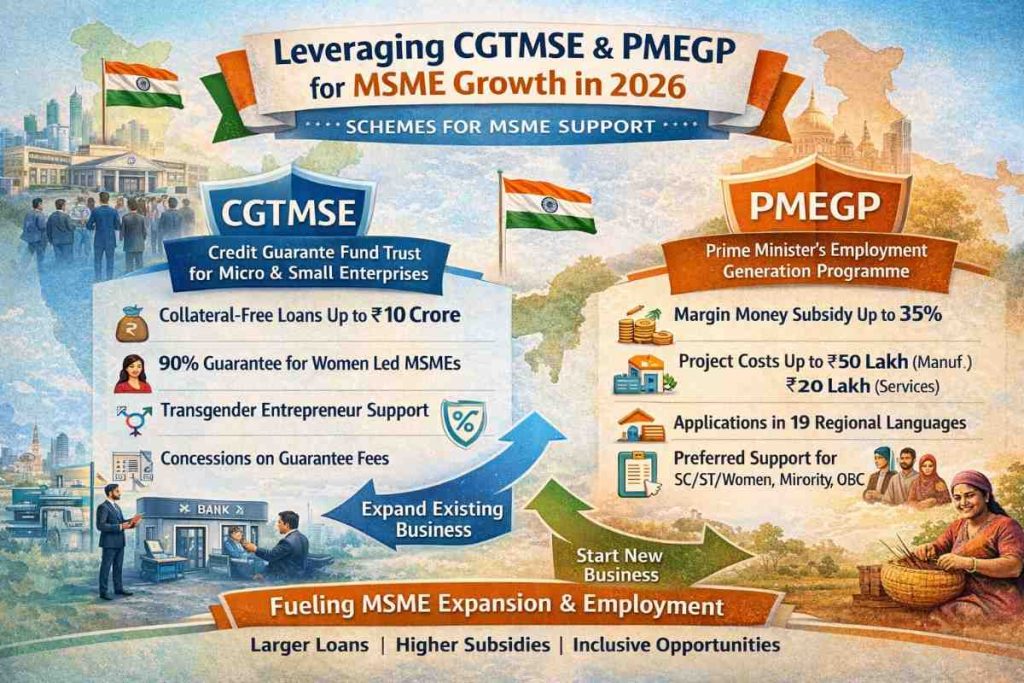
As 2026 unfolds, MSMEs are presented with unprecedented opportunities. The modernization of the CGTMSE and PMEGP schemes signals a proactive approach by the government to ensure that small enterprises can thrive in a rapidly evolving economic landscape. For business owners and aspiring entrepreneurs, understanding and effectively navigating these programs is no longer optional—it is essential for growth, sustainability, and long-term success. With the right strategy and access to these enhanced financial tools, India’s MSME sector is poised to transform potential into tangible impact, fueling innovation, job creation, and inclusive economic development across the country.
Also Read : https://startupmagazine.in/indias-2026-salary-boom-in-ai-and-semiconductors-what-founders-need-to-know/
Add startupupdates.in as preferred source on google – Click Here
About Author

