

As startup ecosystems mature and capital becomes more selective, founders are increasingly discovering that one of their most powerful growth tools is not a large marketing budget but a credible personal brand. Across technology, manufacturing, fintech, and consumer sectors, entrepreneurs are stepping into the public conversation to establish authority, build trust, and attract opportunity — often with little more than consistent insight-sharing and community engagement. What was once considered optional visibility has become a strategic advantage.
Industry observers note that personal branding has shifted from self-promotion to knowledge leadership. In an environment where customers, investors, and partners conduct extensive background research before engaging with a company, a founder’s public voice often serves as the first layer of due diligence. When founders articulate their thinking clearly and repeatedly around a defined problem space, they begin to occupy mental real estate within that domain. Authority emerges not from advertising scale but from demonstrated understanding.
The economics of attention have also changed. Digital platforms now reward expertise and authenticity over production polish. Founders who share operational lessons, market interpretations, product insights, and strategic reflections are building loyal professional audiences without paid amplification. Analysts say this pattern is particularly strong in B2B sectors, where thoughtful commentary can influence purchasing decisions more effectively than traditional brand campaigns.
Communication strategists emphasize that authority-building begins with positioning clarity. Founders who define their thematic territory — whether it is AI deployment, sustainable manufacturing, SaaS pricing, logistics efficiency, or healthcare access — are more likely to be recognized as credible voices. Rather than discussing broad entrepreneurship topics, high-impact founders narrow their public focus to the specific problems they are solving. Over time, repetition and depth create recognition.
Consistency has emerged as the decisive factor. Sporadic visibility rarely produces authority, while steady contribution often does. Founders who publish regular insights, participate in discussions, and respond thoughtfully to industry developments tend to see compounding returns. Audiences begin to anticipate their perspective, and that anticipation builds influence. Content does not need to be lengthy or complex; it needs to be useful and dependable.
A notable trend is the rise of transparent “build-in-public” storytelling. Instead of showcasing only polished milestones, many founders now document their journeys in real time — including experiments, setbacks, hiring decisions, and customer feedback loops. This approach humanizes the entrepreneurial process and strengthens trust. Early adopters and potential collaborators often feel more connected to companies whose leaders communicate openly about progress and challenges.
Community participation has also become a low-cost credibility engine. Active involvement in professional forums, industry groups, technical communities, and founder networks often generates more authority than broadcast-style posting alone. Founders who answer questions, share frameworks, and contribute practical knowledge build reputational capital that spreads through peer recommendation. Such recognition frequently leads to panel invitations, advisory roles, and partnership discussions.
Newsroom editors and conference organizers increasingly confirm that discoverability now begins with a founder’s public writing and commentary. Journalists often identify expert sources through consistent domain content rather than through public relations outreach. This shift has lowered the barrier to media visibility for knowledgeable founders who communicate clearly. As a result, earned exposure is becoming more merit-driven and less budget-driven.
Content efficiency is another advantage for budget-conscious founders. A single well-developed insight can be adapted into multiple formats — a talk, an article, a discussion session, and a newsletter commentary — extending reach without increasing cost. Founders who systematize this reuse gain disproportionate visibility relative to their resource investment.
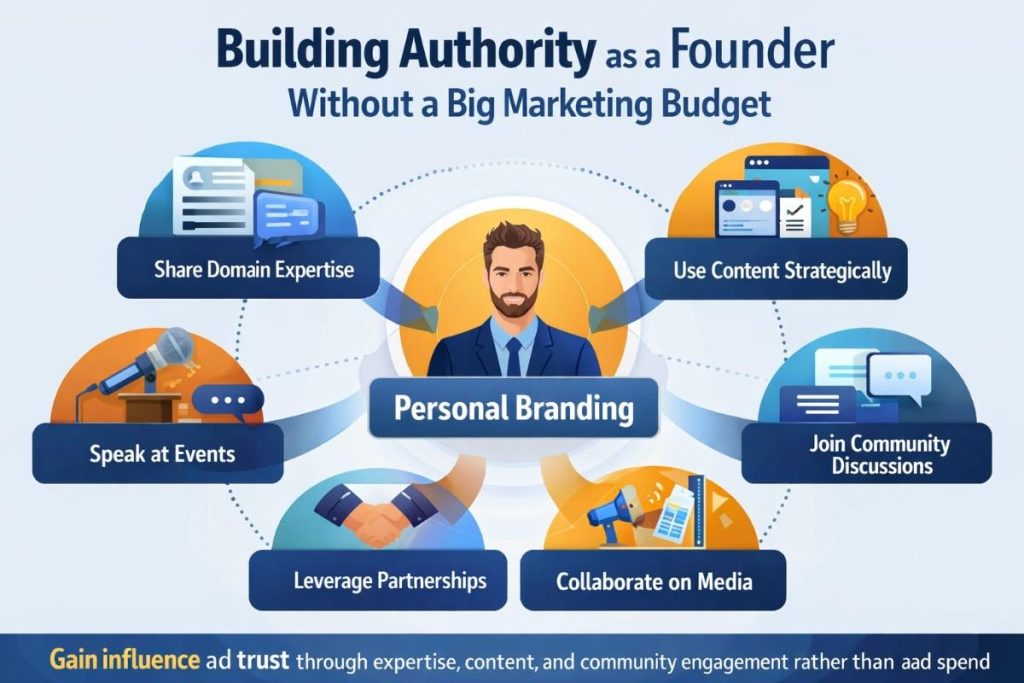
Experts caution, however, that visibility without substance does not translate into authority. Inflated claims, trend-chasing opinions, and exaggerated success narratives may generate short-term attention but often erode long-term trust. Sustainable authority depends on accuracy, originality, and practical value. Credibility, once lost, is expensive to rebuild.
Another critical element is narrative coherence. Founders whose public messaging frequently shifts direction can confuse their audience and weaken perceived expertise. Those who maintain thematic discipline are easier to associate with specific competencies. Over time, that association becomes a brand asset in itself.
Market behavior supports the growing importance of founder-led branding. Enterprise buyers increasingly evaluate leadership thinking alongside product capability. Investors monitor how founders communicate strategy and risk. Prospective employees assess leadership transparency before joining early-stage companies. In each case, personal authority functions as a trust multiplier.
Measurement of branding success has also evolved beyond follower counts. Founders now track inbound investor interest, partnership requests, qualified hiring inquiries, and speaking invitations as indicators of authority growth. These signals often appear well before revenue impact but frequently precede commercial traction.
In a capital-efficient startup era, where marketing expenditure is closely scrutinized, personal branding offers an asymmetric return channel. It converts expertise into visibility and visibility into trust. The founders who benefit most are not necessarily the most promotional but the most consistently informative. As competitive intensity rises, authority will increasingly belong to those who contribute clarity to their industries rather than noise.
Also Read : https://startupmagazine.in/what-investors-look-for-in-seed-rounds-a-checklist-for-first-time-entrepreneurs/
Add startupupdates.in as preferred source and google – Click Here
About Author


