


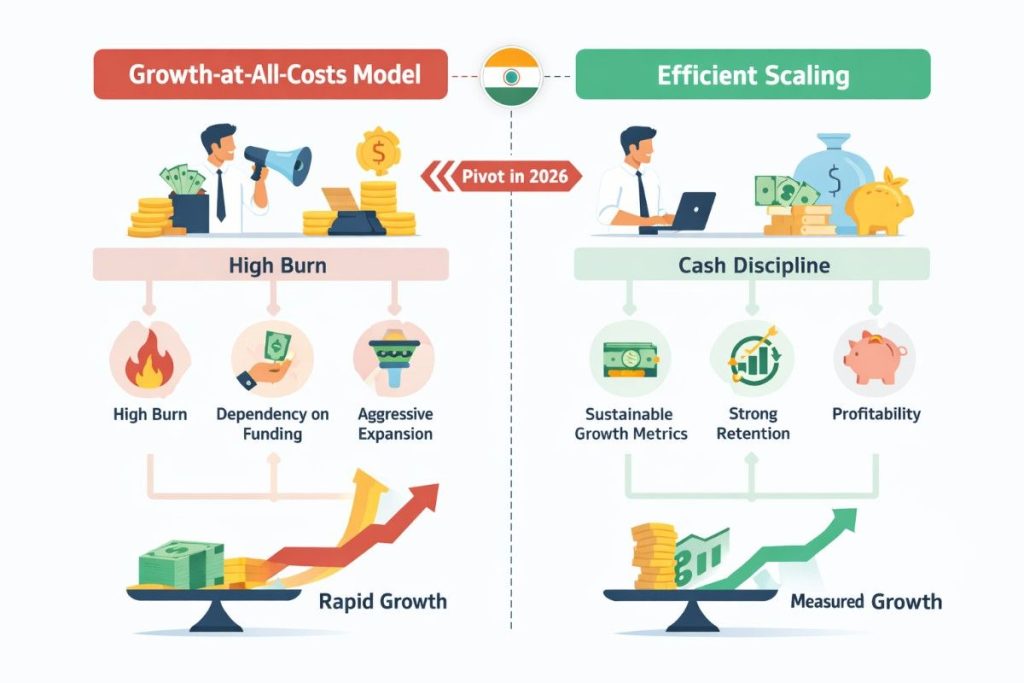
A quiet but decisive shift is underway in India’s software-as-a-service ecosystem. After more than a decade in which speed, scale, and aggressive expansion defined success, SaaS founders are reorienting their strategies around efficient scaling. Growth still matters, but in 2026 it is no longer enough to grow fast. The priority has moved toward growing well—balancing expansion with profitability, capital discipline, and long-term resilience.
This change is rooted in structural realities rather than sentiment. The global cost of capital remains materially higher than it was during the peak funding years, public markets are applying tougher benchmarks to software companies, and enterprise customers are far more deliberate about software spending. For Indian SaaS companies, many of which sell primarily to North American and European customers, these global shifts are directly shaping boardroom decisions at home.
Over the last few years, Indian SaaS has evolved from an emerging niche into a mature sector with meaningful scale. Industry analyses show that a large cohort of Indian SaaS companies generating more than ten million dollars in annual recurring revenue has crossed the fifteen-billion-dollar revenue mark and continues to grow at healthy double-digit rates. Importantly, this cohort is no longer defined by chronic losses; at an aggregate level, it has already reached profitability. As a result, the narrative of “losses today for profits tomorrow” carries less weight than it once did. Investors increasingly expect evidence that a business model can sustain itself even as it expands.
The most immediate pressure point has come from investors themselves. In the post-pandemic funding environment, venture capital firms and growth investors are no longer rewarding topline growth in isolation. Metrics such as net revenue retention, gross margins, customer acquisition payback periods, and free cash flow trajectories now sit at the center of funding conversations. Founders report that rounds are taking longer, diligence is deeper, and valuation discussions hinge on operational quality rather than market size alone. In this environment, efficient scaling has become the strongest signal of credibility.
Public market behavior has reinforced this shift. Over the past two years, global software stocks have undergone sharp valuation corrections, particularly for companies that combined high growth with heavy cash burn. Even when technology companies approach the public markets, offerings are being sized conservatively and priced with caution. For Indian founders with long-term IPO ambitions, this has served as a reminder that public investors are unforgiving when growth is not matched by earnings discipline. Preparing for that scrutiny now, rather than later, is increasingly seen as prudent strategy.
Customer behavior has also changed in ways that directly undermine the growth-at-all-costs model. Enterprise buyers across geographies are rationalizing software stacks, consolidating vendors, and demanding faster proof of return on investment. Large discounts, long sales cycles, and aggressive outbound expansion are no longer reliable levers for durable growth. In response, Indian SaaS companies are narrowing their focus to clearly defined ideal customer profiles, investing more heavily in onboarding and product adoption, and prioritizing expansion revenue only where it is demonstrably profitable. Retention and usage depth, once secondary to logo acquisition, have become central to growth planning.
Artificial intelligence has added another layer of urgency to this pivot. While AI has reduced the cost of building and shipping software features, it has also compressed differentiation in many SaaS categories. Features that once took years to develop can now be replicated far more quickly, intensifying competition. Founders are increasingly aware that efficiency, proprietary data, workflow integration, and distribution strength matter as much as innovation speed. Rather than pursuing broad feature expansion funded by heavy burn, many teams are choosing focused product strategies designed to protect margins and reinforce long-term defensibility.
Macroeconomic conditions continue to loom in the background. Higher interest rates have reshaped how future cash flows are valued, making profitability and cash generation more attractive relative to distant growth. For SaaS companies, this has translated into a more sober understanding of valuation mechanics. The same growth rate that commanded premium multiples in the past now requires a clearer path to earnings. Efficient scaling offers founders a way to regain control over timing and optionality, reducing dependence on frequent capital raises.
What distinguishes the 2026 shift from earlier cycles is its permanence. Indian SaaS is no longer a fledgling sector that can rely on potential alone. With global customers, sizable revenues, and increasing competition, the ecosystem has entered a phase where operational excellence is not optional. Efficient scaling is emerging as the default expectation rather than a defensive posture.
For founders, this means redefining what success looks like. Winning in 2026 is less about the fastest revenue curve and more about building a company that can endure volatility, negotiate from a position of strength, and compound value over time. Growth remains essential, but it is now judged by its quality. In that sense, the pivot away from growth-at-all-costs is not a retreat. It is a sign that Indian SaaS has come of age.
Also Read : Indian SaaS Companies Turn to Vertical AI to Counter Global Subscription Fatigue
Add startupupdates.in as preferred source on google – Click here
About Author


