


Introduction
For more than a decade, consumer startups defined India’s venture capital story.
Food delivery apps, e-commerce platforms, social commerce companies, edtech giants, fintech lenders, and quick-commerce players absorbed billions of dollars in venture funding. The investment logic was simple: India’s rising internet penetration, cheap mobile data, and growing middle class would create one of the world’s largest digital consumer markets.
That thesis produced some of India’s biggest startup names — from Flipkart and Zomato to Byju’s, Swiggy, and Meesho.
But beneath the surface, the mood inside India’s venture ecosystem has changed sharply.
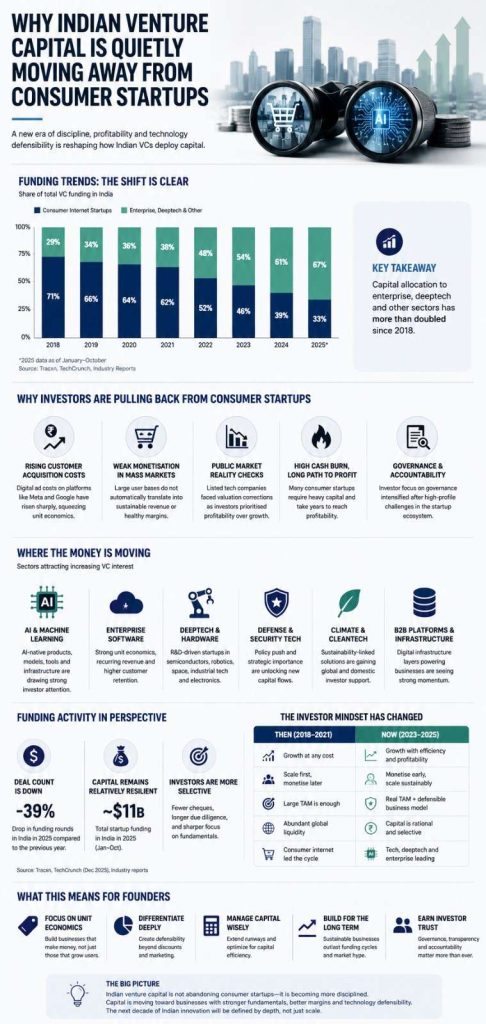
Consumer startups are still getting funded, especially at the top end of the market, but many investors are no longer treating them as the default category for venture-scale returns. Instead, capital is gradually shifting toward artificial intelligence, deeptech, enterprise software, climate tech, defense manufacturing, semiconductor infrastructure, and B2B platforms with clearer unit economics.
The change is not dramatic enough to look like a collapse. It is quieter, more structural, and increasingly visible in fund strategies, partner conversations, and portfolio allocation decisions.
Indian venture capital is not abandoning consumer internet altogether. But it is becoming far more selective about which consumer businesses deserve long-term capital.
The End of the “Growth at Any Cost” Era
Between 2015 and 2021, consumer startups benefited from one of the most aggressive venture cycles in Indian history.
Global liquidity was abundant. Interest rates were low. Large crossover funds and sovereign investors were willing to underwrite massive customer acquisition spending in exchange for rapid market share growth.
Startups competed on scale rather than profitability.
The result was a funding boom across sectors like:
- Food delivery
- Edtech
- D2C brands
- Social commerce
- Mobility
- Online pharmacy
- Gaming
- Instant commerce
That cycle began reversing after 2022 as global capital became more expensive and public market investors started questioning the sustainability of high-burn internet businesses.
Several developments accelerated the shift:
1. Public Market Reality Checks
Many late-stage consumer startups discovered that public markets valued profitability and predictability more than growth narratives alone.
After listing, several Indian internet companies faced volatility in valuations as investors scrutinized:
- Customer acquisition costs
- Cash burn
- Contribution margins
- Retention economics
- Advertising dependency
- Discount-led growth
The correction forced venture investors to rethink exit assumptions.
2. Rising Customer Acquisition Costs
India’s digital advertising ecosystem has matured significantly.
Acquiring users through platforms such as Google and Meta has become more expensive, especially in crowded categories like fintech, commerce, and food delivery. As competition intensified, startups had to spend heavily just to maintain growth.
In many consumer sectors, customer loyalty remained weak, forcing companies into recurring discount cycles.
3. Weak Monetisation in Mass Markets
India remains a price-sensitive market despite rising digital adoption.
Many consumer startups succeeded in building large user bases but struggled to generate durable revenue per user. Investors increasingly realised that scale in India does not automatically translate into venture-scale profitability.
This is particularly true in categories where average order values remain low and logistics costs remain high.
Why Investors Are Turning Toward B2B and Deeptech
The biggest shift in Indian venture capital today is not simply away from consumer startups. It is toward sectors perceived as more defensible and capital-efficient.
AI and Enterprise Software Are Attracting Fresh Capital
Artificial intelligence has become the most visible beneficiary of the shift.
Multiple Indian and global funds are now actively repositioning toward AI-native companies, infrastructure software, developer tools, automation platforms, and enterprise productivity solutions.
Even funds historically associated with consumer investing are now allocating larger portions of capital toward AI and deeptech opportunities.
Lightspeed Venture Partners, for example, is reportedly preparing a smaller India-focused fund with stronger emphasis on AI and early-stage technology investing.
Enterprise Customers Offer Better Revenue Visibility
Compared to consumer internet businesses, enterprise startups often provide:
- Higher contract values
- Recurring revenue
- Better retention
- Lower marketing spend
- More predictable unit economics
That predictability matters in a cautious funding environment.
Investors increasingly prefer businesses where revenue growth is tied to operational value rather than discount-led consumer behaviour.
Government Policy Is Supporting Deeptech
India’s policy environment is also influencing capital allocation.
Government initiatives around semiconductor manufacturing, AI infrastructure, electronics production, defense technology, and manufacturing-linked incentives have created new momentum for industrial and deeptech startups.
The Indian government’s approval of new state-backed venture initiatives focused on advanced technology and deeptech reflects this broader strategic shift.
Consumer Startups Still Raise Capital — But Only the Strongest Ones
The narrative is not that consumer investing has disappeared.
Large consumer brands with strong execution, category leadership, and improving margins continue to attract capital.
Quick commerce remains a good example.
Despite persistent questions around profitability, investors continue backing companies that demonstrate:
- High order frequency
- Dense urban demand
- Logistics efficiency
- Category expansion potential
But the threshold for funding has risen sharply.
Today’s consumer founders are expected to show:
- Strong retention metrics
- Better gross margins
- Lower burn multiples
- Faster paths to profitability
- Operational discipline
The old playbook of “grow first, monetise later” has weakened significantly.
Venture Capital Is Becoming More Concentrated
Another major shift is concentration.
Rather than funding hundreds of broad consumer bets, investors are increasingly concentrating capital into fewer companies with stronger signals.
According to Tracxn data cited by TechCrunch, India’s startup funding ecosystem saw a sharp decline in the number of deals even as total capital remained relatively resilient. Funding rounds reportedly fell nearly 39% in 2025.
This reflects a broader market reality:
- Investors are writing fewer cheques
- Due diligence cycles are longer
- Follow-on funding is harder
- Seed-stage experimentation has slowed
The pullback is especially visible in early-stage consumer startups where differentiation is weak.
The Byju’s Effect on Investor Psychology
Few companies have influenced Indian VC psychology more than Byju’s.
Once celebrated as India’s startup success story, the edtech giant’s governance, debt, and operational challenges became a cautionary example for investors globally.
The fallout extended beyond edtech.
It intensified investor focus on:
- Corporate governance
- Revenue quality
- Financial reporting
- Cash management
- Founder accountability
In many ways, the post-Byju’s environment made investors more sceptical of consumer narratives driven primarily by valuation momentum.
Why Global Macroeconomics Matters
Indian venture capital does not operate independently of global financial markets.
Higher global interest rates, tighter liquidity conditions, geopolitical uncertainty, and weaker late-stage exits have all influenced investor behaviour.
When capital becomes expensive globally, venture firms naturally prioritise businesses with:
- Faster monetisation
- Stronger margins
- Better capital efficiency
- Clearer exit pathways
Consumer startups often require longer timelines and larger capital pools before profitability emerges.
That makes them harder to justify during cautious cycles.
The New Consumer Thesis: Not Mass Market, But Premium Niches
Interestingly, consumer investing itself is evolving rather than disappearing.
Many VCs now prefer consumer businesses targeting:
- Premium urban users
- Health-conscious consumers
- Luxury segments
- Financially affluent millennials
- Specialist communities
Instead of chasing universal scale immediately, newer consumer startups are focusing on high-value cohorts with stronger monetisation potential.
This shift mirrors patterns already visible in mature startup ecosystems globally.
What This Means for Founders
For Indian founders building consumer startups today, the fundraising environment has fundamentally changed.
Investors now expect:
Sustainable Economics From Day One
Founders are increasingly expected to demonstrate discipline much earlier in the company lifecycle.
Growth alone is no longer enough.
Differentiation Beyond Marketing
Consumer brands that rely purely on advertising spend or discounts face greater scrutiny.
Investors are looking for defensibility through:
- Supply chains
- Brand loyalty
- Technology
- Community
- Proprietary distribution
Clearer Paths to Exit
Public market conditions have changed how venture firms think about IPO readiness.
Many investors now evaluate consumer startups through a far more conservative lens than they did during the 2021 funding peak.
The Shift Is Structural, Not Temporary
Some investors believe consumer startup funding will rebound strongly if liquidity conditions improve globally.
That may happen partially.
But the broader change appears structural rather than cyclical.
Indian venture capital is maturing.
Funds are no longer optimising purely for user growth narratives. They are increasingly optimising for durability, governance, capital efficiency, and technological defensibility.
Consumer internet will remain a major part of India’s startup economy. The country’s digital consumption story is still enormous.
But the era when almost any fast-growing consumer app could raise abundant capital at aggressive valuations is clearly fading.
Conclusion
Indian venture capital is undergoing one of its most important strategic transitions since the startup boom began.
The shift away from broad consumer startup investing is not a rejection of India’s digital economy. Instead, it reflects a more disciplined phase in which investors are reassessing risk, profitability, and long-term value creation.
AI, enterprise software, manufacturing tech, and deep infrastructure businesses currently align more closely with what many funds want: defensible technology, stronger margins, and sustainable growth.
Consumer startups are still part of the venture landscape, but they now face a far tougher test.
For founders, the message is increasingly clear: growth matters, but efficient growth matters more.
Also Read : Why Tier-2 Indian Founders Are Building More Profitable Startups Than Bengaluru’s VC Ecosystem
Last Updated on Wednesday, May 20, 2026 4:41 pm by Startup Updates Team
About Author


