


Introduction
For more than a decade, Bengaluru has dominated India’s startup narrative. The city became synonymous with venture capital, unicorns, hypergrowth, and aggressive technology entrepreneurship. It produced some of India’s largest startups and attracted billions in venture funding from global investors.
But beneath the surface of India’s startup boom, another trend has quietly gained momentum.
A growing number of founders from Tier-2 cities — including Indore, Jaipur, Surat, Kochi, Coimbatore, Bhubaneswar, Chandigarh, Nagpur, and Lucknow — are building companies that are often smaller in scale but significantly healthier in economics. Many are profitable earlier, burn less capital, and survive market downturns better than heavily funded startups in Bengaluru’s venture ecosystem.
This shift is not accidental. It reflects structural differences in cost, founder psychology, customer understanding, and capital discipline.
As India’s venture market matures after the post-2021 funding correction, profitability is becoming a stronger indicator of resilience than valuation. In that environment, Tier-2 founders may hold an increasingly important advantage.
India’s Startup Geography Is Expanding Beyond Metro Hubs
India’s startup ecosystem was once concentrated in Bengaluru, Delhi NCR, and Mumbai. However, the rise of digital infrastructure, UPI adoption, affordable internet access, cloud computing, and remote work has dramatically reduced geographical barriers.
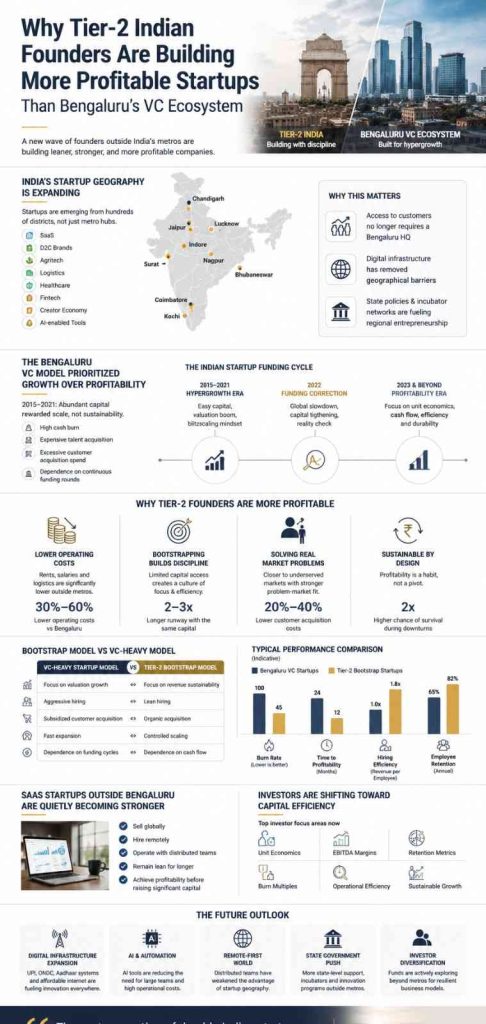
According to the Department for Promotion of Industry and Internal Trade (DPIIT), startups are now emerging from hundreds of Indian districts, not just metropolitan centers. Smaller cities have seen increased participation in sectors such as:
- SaaS
- D2C brands
- agritech
- logistics
- healthcare
- fintech
- creator economy platforms
- AI-enabled SMB tools
The expansion is also visible in incubator networks, state startup policies, and founder communities outside traditional tech hubs.
Cities like Jaipur and Indore have become known for bootstrapped commerce and SaaS startups, while Coimbatore and Kochi are seeing increased deep-tech and industrial software activity.
The result is a more distributed startup economy — one where access to customers no longer requires a Bengaluru headquarters.
The Bengaluru VC Model Prioritized Growth Over Profitability
To understand why Tier-2 founders are often more profitable, it is important to examine how Bengaluru’s venture ecosystem evolved.
Between 2015 and 2021, Indian startups operated in an environment of abundant global liquidity. Venture capital firms rewarded rapid user acquisition, market capture, and top-line growth. Profitability was often considered secondary.
This model worked particularly well for:
- consumer internet platforms
- quick commerce
- edtech
- fintech scaling businesses
- marketplace startups
The emphasis on blitzscaling created companies capable of growing rapidly, but it also normalized:
- high cash burn
- expensive talent acquisition
- excessive customer acquisition spending
- inflated salary structures
- dependence on continuous funding rounds
When global interest rates rose and venture capital slowed after 2022, many startups faced pressure to reduce costs, lay off employees, and move toward sustainable operations.
Several Indian startups publicly shifted focus from “growth at all costs” to EBITDA improvement and cash conservation.
Tier-2 founders, however, had already been operating under those constraints for years.
Why Tier-2 Founders Operate Differently
1. Lower Operating Costs Create Structural Advantages
One of the biggest advantages for Tier-2 startups is dramatically lower operating expenses.
Office rents, salaries, logistics costs, and employee attrition rates are often significantly lower than in Bengaluru.
For example:
- engineering salaries in smaller cities can be materially lower than equivalent metro compensation
- founders often avoid premium office infrastructure
- teams are smaller and more multi-functional
- employee retention tends to be stronger
This creates longer financial runway even without external capital.
A startup earning moderate recurring revenue in a Tier-2 city may survive comfortably with lean operations, whereas a similar startup in Bengaluru may require larger funding rounds simply to sustain overheads.
2. Bootstrapping Culture Encourages Capital Discipline
Many Tier-2 founders begin with limited access to institutional capital.
As a result, they often bootstrap longer, prioritize paying customers early, and avoid unsustainable expansion strategies.
This creates operational habits that differ sharply from VC-driven growth models:
| VC-Heavy Startup Model | Tier-2 Bootstrap Model |
|---|---|
| Focus on valuation growth | Focus on revenue sustainability |
| Aggressive hiring | Lean hiring |
| Subsidized customer acquisition | Organic acquisition |
| Fast expansion | Controlled scaling |
| Dependence on funding cycles | Dependence on cash flow |
This discipline becomes especially valuable during funding slowdowns.
3. Founders Are Building for Real Market Problems
Many Tier-2 entrepreneurs are closer to underserved Indian markets than metro-based startups.
Instead of designing products primarily for affluent urban consumers, they often target:
- SMEs
- regional commerce
- local logistics
- manufacturing digitization
- agricultural supply chains
- vernacular internet users
- Tier-2 and Tier-3 consumers
This proximity creates stronger problem-market fit.
In many cases, founders are solving inefficiencies they have personally experienced in their own regions or industries.
That often results in businesses with:
- clearer monetization
- lower customer acquisition costs
- stronger retention
- less dependence on discounting
SaaS Startups Outside Bengaluru Are Quietly Becoming Stronger
India’s SaaS ecosystem offers one of the clearest examples of this trend.
Several profitable or capital-efficient SaaS firms have emerged from smaller cities where founders deliberately avoided high-burn startup cultures.
These companies often:
- sell globally
- hire remotely
- operate with distributed teams
- remain lean for longer periods
- achieve profitability before raising significant capital
Remote work normalization after the pandemic further reduced the importance of startup geography.
A founder in Jaipur or Coimbatore can now access:
- global customers
- cloud infrastructure
- international payment systems
- AI tools
- distributed talent pools
without relocating to Bengaluru.
This has fundamentally changed startup economics.
The Psychology of Tier-2 Entrepreneurship Is Different
There is also a cultural dimension to this shift.
Founders in major venture ecosystems often face pressure to:
- scale rapidly
- raise large rounds
- chase unicorn status
- prioritize visibility
Tier-2 founders frequently operate with different expectations.
Many focus on:
- long-term sustainability
- family-supported entrepreneurship
- profitability
- steady wealth creation
- operational independence
That mindset can produce slower but healthier businesses.
Importantly, this does not mean Tier-2 founders lack ambition. Instead, many are optimizing for durability rather than valuation optics.
Investors Are Beginning to Value Capital Efficiency Again
The venture slowdown of the past few years has reshaped investor priorities globally.
Funds are now scrutinizing:
- unit economics
- EBITDA margins
- retention metrics
- burn multiples
- operational efficiency
This change benefits founders who built disciplined businesses from the beginning.
Several investors in India have increasingly highlighted “capital-efficient growth” as a preferred characteristic, particularly in SaaS, D2C, and B2B sectors.
Smaller-city startups that once struggled to attract attention because they lacked aggressive growth narratives are now becoming more attractive investment targets.
Challenges Tier-2 Founders Still Face
Despite these advantages, Tier-2 entrepreneurship is not without structural limitations.
Talent Availability
Specialized talent in AI, deep tech, enterprise sales, and product leadership can still be concentrated in metro hubs.
Limited Investor Access
Founders outside major startup clusters may have fewer networking opportunities with institutional investors.
Lower Media Visibility
Many strong businesses from smaller cities remain underreported because India’s startup media ecosystem is still heavily metro-centric.
Scaling Constraints
As startups grow, some eventually relocate functions such as enterprise sales or investor relations to Bengaluru or Mumbai.
The ecosystem gap has narrowed, but it has not disappeared entirely.
India May Be Entering a “Post-Hypergrowth” Startup Era
The broader implication of this trend is that India’s startup ecosystem may be evolving away from pure hypergrowth narratives.
Over the next decade, the strongest companies may not necessarily be those with the highest valuations, but those with:
- sustainable cash flows
- operational resilience
- efficient growth
- deep customer retention
- durable business models
Tier-2 founders appear particularly well-positioned for this environment.
India’s next generation of enduring businesses may emerge not from expensive urban startup clusters, but from founders building quietly in smaller cities with stronger financial discipline.
The Future Outlook
Several long-term trends are likely to accelerate the rise of Tier-2 entrepreneurship:
Digital Infrastructure Expansion
India’s digital public infrastructure — including UPI, Aadhaar-based systems, ONDC initiatives, and affordable internet — continues to lower barriers for startups nationwide.
AI and Automation
AI tools are reducing the need for large teams, allowing smaller startups to operate efficiently from anywhere.
Remote-First Work Models
Distributed teams have weakened the historical advantage of startup geography.
State Government Incentives
Many state governments are actively funding incubators, startup parks, and innovation programs outside metro cities.
Investor Diversification
Funds are increasingly searching beyond Bengaluru for differentiated opportunities and more sustainable economics.
Conclusion
Bengaluru remains India’s most influential startup hub, particularly for venture-backed technology companies. Its ecosystem, talent density, and investor networks are unlikely to lose relevance anytime soon.
But India’s startup story is no longer defined by a single city.
Tier-2 founders are building businesses with a different philosophy — one rooted in efficiency, sustainability, customer relevance, and financial discipline. In a startup environment where profitability is once again becoming important, those qualities matter more than ever.
The next era of Indian entrepreneurship may not belong exclusively to the loudest or most heavily funded startups. It may belong to founders building durable companies far from the country’s traditional venture capital corridors.
Last Updated on Wednesday, May 20, 2026 2:44 pm by Startup Updates Team
About Author


