


India’s logistics technology sector is entering a more mature phase, and trucking platform BlackBuck appears to be among the few scaled startups successfully balancing growth with profitability.
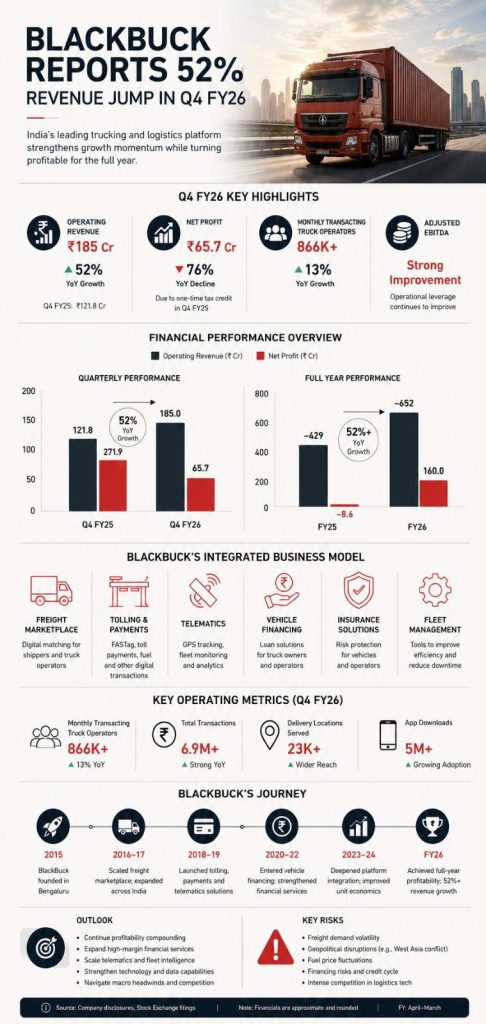
The Bengaluru-based company reported a 52% year-on-year increase in operating revenue for the March quarter of FY26, reaching approximately ₹185 crore, compared with ₹121.8 crore in the same quarter last year. For the full financial year, operating revenue rose to nearly ₹652 crore, up more than 52% from FY25 levels.
The numbers reflect more than just quarterly momentum. They highlight a broader structural shift underway in India’s freight and trucking ecosystem, where digital platforms are increasingly becoming the operating layer for payments, fleet management, financing, tolling, and freight discovery.
At a time when several venture-backed logistics startups are still struggling with weak margins and fragmented demand, BlackBuck’s performance suggests that integrated infrastructure-led logistics models may finally be reaching operational scale.
A Strong Revenue Quarter, But Profit Requires Context
BlackBuck’s Q4 FY26 revenue growth was accompanied by a sharp decline in reported net profit, which fell around 76% year-on-year to ₹65.7 crore. However, the comparison is distorted by a one-time deferred tax credit received during the corresponding quarter last year.
Without adjusting for that exceptional item, the company’s underlying profitability trajectory appears considerably healthier than headline comparisons suggest.
For the full fiscal year, BlackBuck reported a net profit of around ₹160 crore versus a net loss of roughly ₹8.6 crore in FY25.
The company’s operational scale also continued expanding:
- Average monthly transacting truck operators rose 13% year-on-year to over 866,000 in Q4 FY26
- Growth businesses, including vehicle financing and newer logistics products, continued gaining traction
- Adjusted EBITDA improved significantly during FY26, according to company disclosures and earnings commentary
This matters because logistics technology businesses historically faced two major challenges in India: low user stickiness and thin monetisation. BlackBuck’s latest results suggest that multi-product monetisation across the trucking ecosystem may be helping offset those structural weaknesses.
Why BlackBuck’s Growth Matters for India’s Logistics Economy
India’s trucking industry remains one of the country’s largest yet least efficiently organised sectors.
Road transport accounts for the overwhelming majority of domestic freight movement in India, but the industry is still highly fragmented, dominated by small fleet operators and independent truck owners. Digitisation levels remain uneven across financing, tolling, load matching, and operational management.
BlackBuck’s business model has evolved over the years from a freight marketplace into a broader trucking operating system.
Its current offerings include:
- Freight marketplace services
- FASTag and tolling payments
- Fuel and payments infrastructure
- GPS-based telematics
- Vehicle financing
- Fleet management tools
This diversification is strategically important because pure freight aggregation businesses often struggle with cyclical demand and pricing pressure. Infrastructure-oriented services such as payments and telematics typically generate more recurring and defensible revenue streams.
The company’s scale also aligns with larger policy trends:
GST and Formalisation
India’s Goods and Services Tax regime accelerated freight formalisation by creating national logistics corridors and reducing interstate bottlenecks.
FASTag Penetration
Digital tolling has dramatically increased transaction digitisation across highways, creating new monetisation opportunities for logistics platforms.
E-commerce Expansion
The growth of e-commerce, quick commerce, and organised retail has increased demand for predictable freight networks and technology-enabled fleet visibility.
Fleet Financing Gap
Small truck operators often remain underserved by traditional banks, creating opportunities for embedded financing models.
BlackBuck sits at the intersection of all four trends.
The Profitability Shift in Indian Startup Logistics
For years, Indian logistics startups prioritised scale over sustainable margins. Aggressive discounting, freight wars, and capital-heavy expansion strategies defined the sector.
That environment is changing.
Following the broader global startup funding slowdown that began in 2022–23, investors increasingly shifted attention toward:
- contribution margins
- operational efficiency
- recurring revenue
- capital discipline
BlackBuck’s FY26 performance reflects that transition.
The company’s management indicated during post-results commentary that profitability compounding and operating leverage remain key priorities even as competition increases.
This marks a notable evolution from earlier years when logistics startups were largely evaluated on gross transaction value rather than earnings quality.
Several broader trends are now reshaping the sector:
1. Consolidation Over Hypergrowth
The market is gradually favouring larger integrated platforms with existing network density.
2. Infrastructure Monetisation
Payments, financing, insurance, and telematics are emerging as higher-margin layers compared with freight matching alone.
3. AI and Fleet Intelligence
Predictive routing, fleet analytics, and driver optimisation are becoming more commercially viable as logistics digitisation deepens.
4. Public Market Discipline
As more startup-backed companies become publicly listed, quarterly scrutiny around margins and governance is intensifying.
BlackBuck’s results indicate that the company is adapting relatively well to this new environment.
Risks and Challenges Remain Significant
Despite strong growth, the company faces meaningful external and operational risks.
BlackBuck noted that the ongoing West Asia conflict could create short-term pressure on freight movement and transaction-linked revenues.
Global supply chain disruptions often affect Indian trucking volumes indirectly through:
- export-import flows
- fuel costs
- industrial demand cycles
- shipping delays
The logistics sector also remains intensely competitive.
Large players across freight aggregation, fleet software, and mobility infrastructure continue expanding aggressively. Traditional logistics firms are also investing heavily in technology transformation.
Margin pressure may intensify if:
- freight demand weakens
- financing defaults rise
- fuel volatility increases
- customer acquisition costs climb
In addition, logistics technology remains operationally complex in India due to fragmented ownership structures and regional variations in transport operations.
Scaling profitably while maintaining service reliability will remain a key test for BlackBuck over the next few years.
BlackBuck’s Business Model Is Becoming More Financial Infrastructure-Oriented
One of the more underappreciated aspects of BlackBuck’s evolution is its gradual transition from marketplace startup to logistics financial infrastructure company.
The strongest long-term economics in logistics platforms often emerge not from freight brokerage itself, but from the financial and operational rails surrounding freight movement.
This includes:
- toll payments
- fuel payments
- credit underwriting
- insurance
- fleet subscriptions
- embedded financial services
These layers tend to generate:
- repeat transactions
- higher retention
- lower churn
- richer operational data
If BlackBuck can continue deepening monetisation across these categories, it may reduce dependence on volatile freight marketplace commissions over time.
That could significantly improve earnings predictability.
Public Market Expectations Are Also Changing
Investor expectations from listed Indian technology companies have become considerably more demanding.
Growth alone is no longer enough.
Markets increasingly reward:
- sustained EBITDA expansion
- cash flow visibility
- disciplined capital allocation
- operating leverage
BlackBuck’s transition into profitability therefore carries symbolic importance beyond its own business performance.
It signals that parts of India’s logistics startup ecosystem may finally be moving beyond subsidy-driven expansion models into more durable commercial structures.
Whether that profitability remains sustainable through freight cycles will determine how investors ultimately value the business.
The Road Ahead
India’s logistics sector is expected to undergo substantial structural transformation over the next decade.
Government infrastructure spending, manufacturing expansion, ONDC-linked commerce growth, and supply chain digitisation are likely to increase demand for integrated freight technology platforms.
BlackBuck appears well-positioned to benefit from:
- rising digital adoption among truck operators
- embedded finance demand
- highway digitisation
- fleet software penetration
However, execution risks remain high.
The next phase of growth will likely depend less on acquiring users and more on:
- increasing monetisation per operator
- improving retention
- maintaining margins
- scaling financing responsibly
- expanding high-frequency transaction services
The company’s FY26 results suggest meaningful progress, but the logistics technology sector remains one of India’s toughest operational markets.
Sustained profitability — not just rapid growth — will ultimately determine whether BlackBuck becomes a long-term logistics infrastructure leader or simply another cyclical transport platform.
Also Read : Indian Agentic AI Startups Raise $60 Million in Just 4.5 Months as Enterprise Adoption Accelerates
Last Updated on Thursday, May 21, 2026 2:51 pm by Startup Updates Team
About Author


