


India’s artificial intelligence startup ecosystem is entering a new phase — one that investors increasingly believe could move beyond chatbots and copilots into autonomous software systems capable of executing tasks with minimal human intervention.
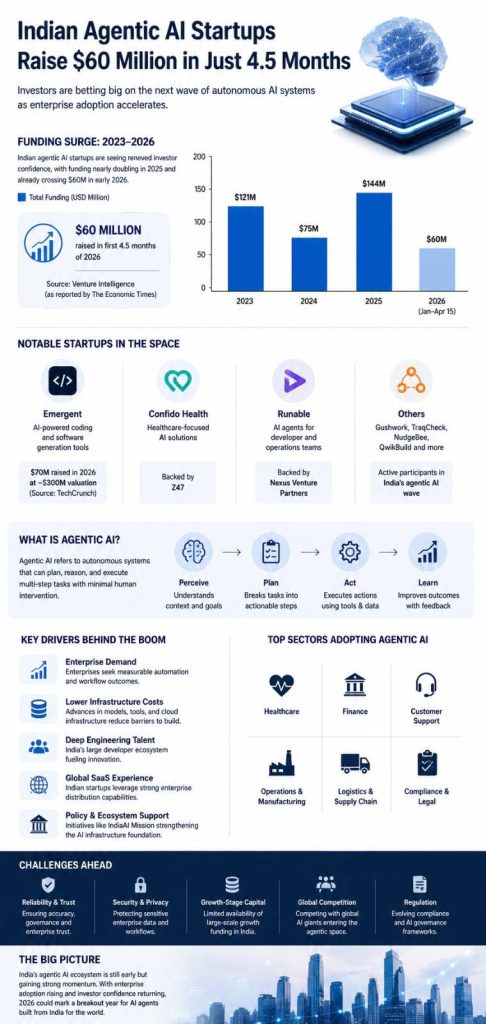
In the first four-and-a-half months of 2026, Indian agentic AI startups raised nearly $60 million, according to data cited by Venture Intelligence and reported by The Economic Times. The surge reflects growing investor conviction that “AI agents” — software systems designed to independently reason, plan, and complete workflows — may become one of the most commercially viable layers of the generative AI economy.
The funding momentum also signals a broader shift underway in India’s startup ecosystem. After two years dominated by efficiency resets, profitability pressures, and cautious venture deployment, investors appear increasingly willing to fund AI-native startups again — particularly those building enterprise-focused automation infrastructure.
Yet beneath the excitement lies a more complex story. While funding is rising, India’s agentic AI sector remains early-stage, highly competitive, and still dependent on proving durable enterprise value.
What Is Agentic AI — and Why Are Investors Interested?
Agentic AI refers to autonomous AI systems that can execute multi-step tasks with limited supervision. Unlike traditional generative AI tools that primarily respond to prompts, agentic systems are designed to plan actions, use tools, retrieve information, make decisions, and complete workflows.
Examples include:
- AI coding agents
- Autonomous customer support systems
- AI sales and operations assistants
- Workflow automation agents
- AI procurement and compliance systems
- Industry-specific execution platforms
The category has rapidly gained traction globally following improvements in large language models (LLMs), reasoning systems, retrieval infrastructure, and orchestration frameworks.
For Indian startups, the opportunity is especially compelling because many are building for global enterprise clients while leveraging India’s comparatively cost-efficient engineering talent pool.
According to Tracxn data referenced in recent reports, more than 100 agentic AI startups have been founded in India since 2023.
That number reflects how quickly the category has moved from experimental prototypes to venture-backed businesses.
The Funding Numbers Behind the Momentum
The latest funding data suggests the category is evolving faster than many investors anticipated.
According to Venture Intelligence data:
- Indian agentic AI startups raised $121 million in 2023
- Funding fell to $75 million in 2024
- Investments nearly doubled to $144 million in 2025
- Startups have already raised $60 million in the first 4.5 months of 2026
If current momentum continues, 2026 could surpass last year’s funding total despite broader venture capital caution across sectors.
Several startups are reportedly attracting strong investor attention:
Notable Funding Activity
- Emergent reportedly raised $70 million earlier this year, according to TechCrunch, at a valuation of around $300 million. The company focuses on AI-powered coding and software generation tools.
- Healthcare-focused AI startup Confido Health reportedly secured funding from Z47.
- Runable reportedly raised capital from Nexus Venture Partners.
- Startups such as Gushwork, TraqCheck, NudgeBee, and QwikBuild are also participating in the broader agentic AI wave.
Some funding details remain privately sourced or unconfirmed publicly, underscoring how early-stage much of the sector still is.
Why Agentic AI Is Different From the Earlier GenAI Wave
The first phase of India’s generative AI boom largely revolved around wrappers, chatbots, content generation tools, and productivity copilots.
Agentic AI represents a more ambitious layer.
Instead of merely assisting users, these systems attempt to complete end-to-end actions — writing code, handling workflows, scheduling operations, resolving tickets, or interacting with enterprise systems autonomously.
This transition matters commercially because enterprises are increasingly seeking measurable operational outcomes rather than experimental AI deployments.
Several founders interviewed by The Economic Times said enterprises now have greater clarity around the practical utility of AI agents, leading to more pilot projects and scaled deployments.
That clarity is critical for investors.
Over the past two years, one of the largest concerns around generative AI startups globally has been monetization durability. Many companies demonstrated impressive product demos but struggled to convert experimentation into stable recurring revenue.
Agentic AI startups, by contrast, are increasingly positioning themselves as workflow infrastructure businesses rather than standalone AI applications.
Enterprise Adoption Is Becoming the Real Story
A major reason investors are revisiting AI infrastructure startups is improving enterprise willingness to pay for automation.
India’s SaaS ecosystem spent years building global enterprise distribution capabilities. Agentic AI startups are now leveraging those same channels.
Several early trends are emerging:
1. Vertical AI Is Gaining Traction
Generic AI agents remain difficult to scale reliably. Instead, startups are focusing on highly specific workflows in industries such as:
- Healthcare
- Construction
- Finance
- Operations
- Logistics
- Customer support
- ERP automation
This vertical specialization allows startups to build domain-specific datasets and workflow intelligence.
2. Revenue Quality Is Improving
Investors are paying close attention to recurring enterprise contracts rather than vanity user growth.
The Economic Times report noted that some investors are seeing “improved quality of revenue” among Indian AI startups serving large global enterprises.
That distinction is important in a venture market increasingly skeptical of growth without defensibility.
3. AI Infrastructure Costs Are Falling
Advances in open-source models, inference optimization, orchestration frameworks, and cloud tooling are lowering the barriers to building agentic systems.
QwikBuild cofounder Pradeep Ayyagari noted that newer models such as Claude Opus have improved agent reliability because code is increasingly embedded into operational logic rather than relying solely on natural language prompting.
This shift could significantly improve scalability.
India’s Structural Advantage in Agentic AI
India may be particularly well-positioned in agentic AI for several reasons.
Deep Engineering Talent
India remains one of the world’s largest software developer ecosystems.
GitHub recently noted strong developer growth from India, with increasing participation in AI-related open-source contributions.
That engineering depth matters because agentic systems require orchestration, infrastructure engineering, integrations, and workflow reliability — not just prompt engineering.
Global SaaS Experience
Indian founders already understand enterprise software distribution.
The country’s SaaS ecosystem spent over a decade building global B2B businesses, especially targeting U.S. and European enterprises. Agentic AI startups are building atop that foundation.
Cost Arbitrage
Indian startups can often build AI products at lower operational costs compared to Silicon Valley peers while targeting the same enterprise clients.
This improves experimentation velocity and runway efficiency.
Government AI Push
India’s broader AI policy environment is also evolving.
The IndiaAI Mission, GPU infrastructure initiatives, and increasing AI-focused venture activity are helping create a more supportive ecosystem for AI-native startups.
But Major Challenges Remain
Despite the optimism, the sector still faces significant risks.
Growth-Stage Capital Is Still Limited
Most funding continues to concentrate at the seed and early stages.
India still lacks large-scale growth-stage AI financing compared to U.S. or Chinese ecosystems. The Economic Times report specifically highlighted the shortage of growth-stage capital for AI startups.
Competition Is Intensifying
Global AI incumbents are moving aggressively into enterprise automation.
OpenAI, Anthropic, Microsoft, Google, Salesforce, ServiceNow, and others are all expanding agentic capabilities.
Indian startups will likely need:
- Deep vertical specialization
- Proprietary workflow data
- Distribution advantages
- Enterprise trust
- Regulatory reliability
to remain competitive.
Reliability and Governance Concerns
Agentic AI systems introduce higher operational risk than traditional AI assistants because they can autonomously perform actions.
Enterprises remain cautious about:
- Hallucinations
- Compliance failures
- Data privacy
- Workflow errors
- Security vulnerabilities
- Auditability
The startups that survive may ultimately be those that solve reliability and governance challenges better than competitors.
Investors Are Becoming More Selective
The current funding environment differs sharply from the 2021 startup boom.
Investors today are prioritizing:
- Revenue quality
- Enterprise retention
- AI infrastructure efficiency
- Clear use cases
- Deployment scalability
- Gross margin sustainability
This explains why many funded agentic AI startups are focused on enterprise workflows rather than consumer AI applications.
A broader pattern is also emerging across India’s startup ecosystem: capital is increasingly flowing toward infrastructure-heavy, defensible deep-tech categories instead of pure growth-led consumer internet businesses.
The Next Phase: From Copilots to Autonomous Workflows
The most important transition in AI may not be chat interfaces — it may be autonomous execution.
That shift could fundamentally alter how enterprises operate.
In the near term, India’s agentic AI ecosystem will likely evolve around:
- AI-enabled enterprise operations
- AI-native SaaS platforms
- Autonomous software engineering tools
- Workflow orchestration systems
- Domain-specific automation agents
However, whether Indian startups can build globally dominant agentic AI companies remains uncertain.
The sector is still early, infrastructure costs remain significant, and global competition is accelerating rapidly.
Still, the recent funding surge suggests investors increasingly believe India could become more than just a consumer of AI tools — it could become a builder of globally relevant AI infrastructure businesses.
And for a startup ecosystem searching for its next major platform shift after fintech and SaaS, agentic AI may now be emerging as the strongest contender.
Also Read : Why Indian Venture Capital Is Quietly Moving Away From Consumer Startups
Last Updated on Wednesday, May 20, 2026 6:27 pm by Startup Updates Team
About Author


