

India’s startup ecosystem spent the better part of the last decade optimizing for scale through paid acquisition, app installs, and marketplace subsidies. That playbook is beginning to lose efficiency.
Customer acquisition costs are rising across digital platforms. Performance marketing is increasingly crowded. Trust in traditional advertising continues to decline, especially among younger internet users who consume content through creators rather than institutions.
In response, a growing number of Indian startups are turning creators into something far more strategic than brand ambassadors. Creators are becoming distribution infrastructure.
From fintech and D2C brands to edtech, health-tech, SaaS, and commerce platforms, startups are increasingly relying on creators not only for awareness but also for customer acquisition, community building, product education, and even retention.
The shift reflects a larger transformation underway in India’s digital economy: content is no longer just marketing. It is becoming commerce infrastructure.
The Creator Economy Has Moved Beyond Influence
India’s creator economy has grown rapidly over the last five years, fueled by cheap mobile data, short-video platforms, vernacular internet adoption, and the expansion of digital payments.
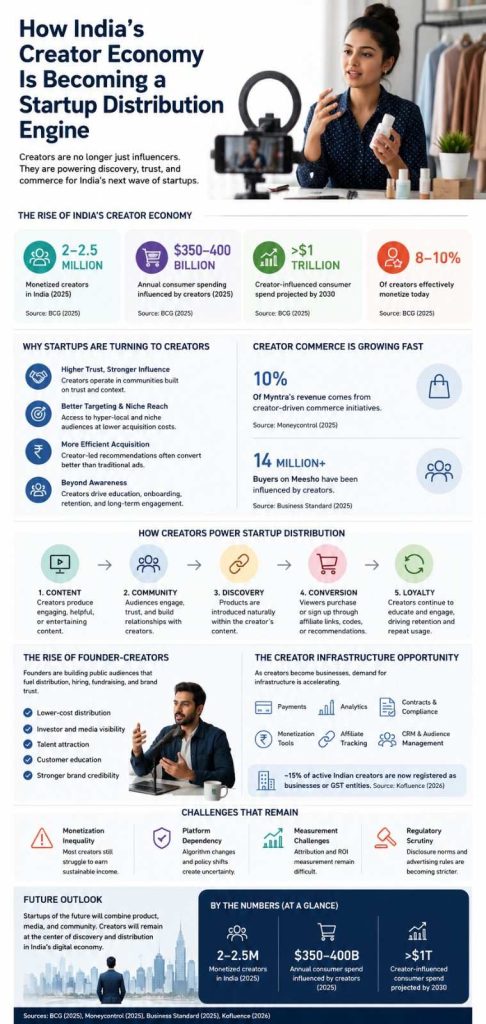
According to a 2025 report by BCG, India now has roughly 2–2.5 million monetized creators influencing $350–400 billion in annual consumer spending. The report projects creator-influenced consumption could exceed $1 trillion by 2030.
The more important shift, however, is structural rather than numerical.
Creators are evolving from media personalities into distribution nodes with measurable economic impact.
This is particularly visible in sectors where trust, education, and community engagement directly affect purchasing decisions:
- fintech
- beauty and personal care
- health and wellness
- gaming
- fashion commerce
- productivity tools
- online learning
- AI tools and SaaS products
Unlike traditional digital advertising, creators operate within audience communities that already possess contextual trust. That changes conversion dynamics.
A consumer may ignore a display ad for a budgeting app, but a finance creator documenting their investing habits or tax-saving strategies can drive significantly higher engagement and product adoption.
For startups, this is not merely “influencer marketing.” It is audience transfer.
Why Distribution Has Become the Hardest Startup Problem
The Indian startup ecosystem has matured dramatically since the 2020–2021 funding boom.
Capital is no longer as abundant. Growth-at-all-costs models are under pressure. Investors are prioritizing sustainable customer acquisition and stronger retention economics.
As a result, founders are rethinking distribution.
Historically, Indian internet startups depended heavily on:
- Meta and Google advertising
- app-store optimization
- discount-led acquisition
- referral incentives
- celebrity endorsements
- marketplace visibility
Those channels still matter, but returns have weakened.
Privacy changes, rising competition, and algorithm volatility have made paid acquisition more expensive and less predictable. In some sectors, CAC inflation has materially affected profitability timelines.
Creators offer an alternative model: community-driven discovery.
Instead of interrupting users with ads, startups increasingly integrate themselves into content ecosystems where users already spend time voluntarily.
This is especially effective in India, where content consumption is exploding across regional languages and Tier-2 and Tier-3 cities.
A 2026 Kofluence report noted that more than 62% of creators reported increased demand for regional-language brand collaborations, reflecting brands’ push toward hyper-local engagement.
Creators Are Becoming the New Discovery Layer
One of the clearest signals of this shift is the rise of creator-led commerce.
Platforms like Myntra, Meesho, and other consumer internet companies are actively building creator ecosystems into their core business models.
According to a 2025 report by Moneycontrol, creator-driven commerce already contributes roughly 10% of Myntra’s revenue through shoppable content initiatives and affiliate ecosystems.
Similarly, Meesho said over 14 million buyers on its platform were influenced by creators, prompting the launch of a dedicated creator marketplace initiative.
These developments matter because they signal a deeper evolution:
Creators are no longer external marketing partners. They are embedded into transaction funnels.
This mirrors trends seen globally with TikTok Shop, YouTube Shopping, and affiliate-driven commerce ecosystems. But India’s version is evolving differently due to its unique internet demographics.
India’s next wave of internet users is largely mobile-first, vernacular-first, and video-native. In that environment, creator-led recommendations often outperform conventional product discovery mechanisms.
For startups targeting Bharat consumers, creators can effectively serve as:
- trust intermediaries
- localized educators
- onboarding channels
- cultural translators
- commerce catalysts
The Rise of Founder-Creators
Another defining trend is the emergence of founder-creators.
Indian founders are increasingly building public audiences alongside their startups.
This is visible across SaaS, D2C, AI, productivity, investing, and B2B ecosystems where founders actively use:
- X
- YouTube
- podcasts
- newsletters
- WhatsApp communities
- Telegram channels
The strategy serves multiple purposes:
- lower-cost distribution
- hiring visibility
- investor attention
- customer education
- trust building
- organic inbound growth
In many cases, the founder’s audience becomes the startup’s first acquisition engine.
This approach is especially valuable for early-stage startups that lack large marketing budgets.
The phenomenon is also changing how startups think about branding. Instead of building faceless corporate identities, companies increasingly build around personalities, narratives, and communities.
The result is a more media-native startup ecosystem.
Why Community-Led Distribution Works Better in India
India’s internet behavior differs meaningfully from Western markets.
Discovery in India is increasingly driven by:
- short-form video
- creator recommendations
- WhatsApp sharing
- regional-language content
- community participation
This is partly due to trust dynamics.
Consumers in emerging internet markets often rely more heavily on social proof and peer-led validation than on institutional advertising.
That creates fertile ground for creator-driven distribution.
Nano and micro creators are especially important here.
While celebrity influencers dominate visibility, smaller creators frequently drive stronger engagement because their audiences perceive them as more authentic and relatable.
The Kofluence report found that over 61% of surveyed creators fell into the nano category (1,000–10,000 followers).
For startups, these creators often provide:
- lower acquisition costs
- niche targeting
- regional penetration
- higher engagement rates
- community credibility
This is particularly relevant for startups expanding beyond metro markets.
The Infrastructure Opportunity Behind the Creator Economy
As the creator economy matures, a second-order startup opportunity is emerging: creator infrastructure.
India’s creator ecosystem still suffers from fragmented tooling around:
- payments
- analytics
- contracts
- taxation
- monetization
- audience ownership
- CRM
- affiliate tracking
That gap is creating opportunities for SaaS and fintech startups building creator-focused infrastructure.
Increasing formalization is accelerating this trend.
According to Kofluence, roughly 15% of active Indian creators are now registered as businesses or GST entities, a sign that creators are evolving into formal economic participants rather than casual influencers.
As creator businesses professionalize, demand for operational tooling will likely expand significantly.
This mirrors earlier platform transitions in India’s startup ecosystem:
- sellers needed Shopify-like infrastructure
- SMBs needed digital payments
- gig workers needed financial tools
Now creators need business infrastructure.
Risks and Challenges Remain Significant
Despite the momentum, the creator economy is not a frictionless growth engine.
Several structural problems persist.
Monetization Inequality
A large percentage of creators still struggle to earn sustainable income. Even as the ecosystem grows, revenue concentration remains heavily skewed toward top creators.
The BCG report noted that only 8–10% of creators effectively monetize today.
This limits long-term sustainability for many creator-led business models.
Platform Dependency
Creators remain vulnerable to:
- algorithm changes
- platform policy shifts
- demonetization risks
- declining organic reach
For startups relying too heavily on creator-led acquisition, this creates channel concentration risk.
Measurement Challenges
Attribution remains difficult.
Many startups still struggle to accurately measure:
- creator-driven conversions
- retention quality
- incremental lift
- long-term customer value
As budgets increase, demands for measurable ROI will intensify.
Regulatory Scrutiny
India’s advertising and influencer disclosure norms are tightening.
Regulators are increasingly focused on:
- undisclosed promotions
- misleading endorsements
- financial product advertising
- health claims
As the industry institutionalizes, compliance requirements will likely become stricter.
The Future: Startups Are Becoming Media Companies
The most important long-term shift may be philosophical.
Startups are beginning to realize that distribution is no longer separate from media.
In the next phase of India’s internet economy, successful startups may increasingly resemble hybrid entities:
- product companies
- community builders
- content publishers
- creator networks
This is already visible across sectors:
- fintech firms building educational content ecosystems
- D2C brands launching creator communities
- SaaS startups operating newsletters and podcasts
- commerce companies integrating shoppable video
- AI startups growing through founder-led content
The lines between media, commerce, and technology are blurring rapidly.
In that environment, creators are not simply marketing channels.
They are becoming foundational infrastructure for digital distribution.
Conclusion
India’s creator economy is entering a more mature and institutional phase.
What began as influencer-led entertainment is evolving into a powerful distribution layer for startups seeking efficient growth in an increasingly competitive digital economy.
For founders, creators now offer more than visibility:
- they provide trust
- contextual discovery
- community access
- regional reach
- conversion leverage
At the same time, the creator economy itself is creating entirely new startup opportunities in infrastructure, monetization, analytics, and commerce enablement.
The broader implication is clear: the future of startup distribution in India may belong less to traditional advertising networks and more to networks of creators who already command attention, trust, and cultural relevance.
The companies that understand this shift early are likely to build stronger consumer relationships — and potentially more durable businesses — in India’s next internet decade.
Also Read : Info Edge’s Investments Power Profit Surge as Core Recruitment Business Holds Firm
Last Updated on Saturday, May 23, 2026 8:13 pm by Startup Updates Team
About Author


