

India’s startup ecosystem spent the better part of the last decade celebrating company creation. Venture capital rewarded founders who could launch quickly, acquire customers aggressively, and scale categories through capital-intensive expansion.
But as funding conditions tightened after 2022 and profitability became a central investor concern, a quieter but increasingly influential trend began taking shape: startup roll-ups.
Instead of building brands from scratch, a growing number of Indian companies are now buying existing digital-first businesses, regional consumer brands, SaaS products, and niche online sellers. The logic is straightforward. Acquiring a functioning business with customers, distribution, and cash flow can often be cheaper, faster, and less risky than starting anew.
What began with Amazon marketplace aggregators has now evolved into a broader consolidation strategy across consumer goods, beauty, food, wellness, SaaS, and even creator-led commerce.
India may still be in the early stages of the roll-up economy, but the model is rapidly becoming one of the most important structural shifts in the country’s startup landscape.
Understanding the Roll-Up Model
A startup roll-up typically acquires multiple smaller businesses operating within the same or adjacent categories and integrates them under a larger operational platform.
The strategy is not new globally. In the United States, firms like Thrasio popularized the model by acquiring successful third-party sellers on Amazon. Similar approaches later spread into software, healthcare, consumer goods, and services.
In India, the model has adapted to local market realities.
Rather than purely buying Amazon-native brands, Indian roll-up startups are targeting:
- D2C consumer brands
- Regional FMCG businesses
- Beauty and personal care labels
- Wellness and nutrition brands
- Home and kitchen sellers
- SaaS tools with stable recurring revenue
- Digital-first lifestyle brands
- Creator-led commerce businesses
The goal is operational leverage. Shared logistics, marketing, manufacturing, procurement, technology, and distribution can improve margins across acquired companies.
For investors, roll-ups offer another advantage: predictable revenue acquisition instead of uncertain product-market fit experimentation.
Why Roll-Ups Are Rising in India Now
Several structural changes in India’s startup ecosystem are accelerating the trend.
1. The Funding Winter Changed Founder Priorities
After the funding slowdown of 2022 and 2023, venture capital firms shifted focus from growth-at-all-costs to sustainable economics.
This fundamentally altered acquisition logic.
Building a new consumer brand from zero requires:
- heavy customer acquisition spending,
- influencer marketing,
- inventory investment,
- marketplace discounting,
- and long gestation periods.
Buying an already profitable or revenue-generating business can significantly shorten that cycle.
Many investors now prefer businesses with:
- existing cash flows,
- operational history,
- and measurable consumer demand.
That preference directly benefits acquisition-led growth strategies.
2. Thousands of Small Digital Brands Exist — But Many Have Plateaued
India’s D2C boom produced thousands of niche brands across categories such as skincare, nutrition, fashion, home décor, and packaged food.
Platforms like:
- Shopify,
- Amazon India,
- Flipkart,
- and Instagram
dramatically lowered barriers to entry.
But scaling beyond early traction proved difficult.
Many founders discovered that:
- customer acquisition costs were rising,
- repeat purchase rates were inconsistent,
- and offline expansion required capital and operational expertise.
As a result, numerous small but viable brands reached a ceiling. That created a large acquisition pipeline for consolidators.
3. India’s Consumer Internet Is Fragmented
Unlike more consolidated Western retail markets, India remains highly fragmented across:
- geography,
- language,
- distribution,
- and consumer preferences.
This fragmentation creates room for multi-brand portfolio companies.
Instead of betting on a single national brand, roll-up startups can operate a portfolio tailored to different customer segments and price points.
This resembles older FMCG playbooks historically used by conglomerates like Hindustan Unilever and ITC Limited, but with digital-first distribution and startup-style execution.
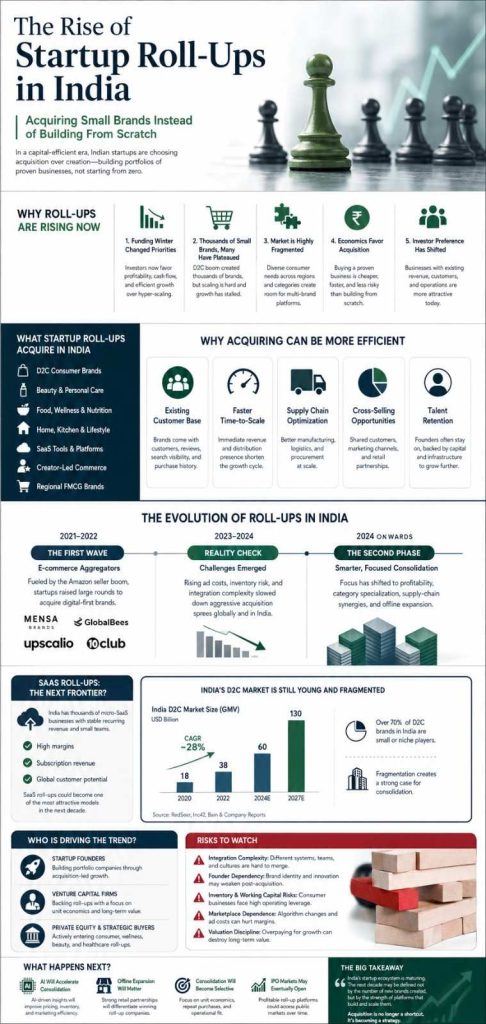
The First Wave: E-Commerce Aggregators
India’s earliest visible roll-up startups emerged during the Amazon seller aggregation boom between 2021 and 2022.
Companies such as:
- Mensa Brands,
- GlobalBees,
- Upscalio,
- and 10Club
raised substantial venture funding to acquire and scale digital-first brands.
The pitch was compelling:
- identify fast-growing online brands,
- acquire majority ownership,
- improve operations,
- optimize supply chains,
- and expand omnichannel distribution.
Some companies focused on marketplace sellers, while others pursued broader D2C strategies.
Mensa Brands
Founded by former Myntra CEO Ananth Narayanan, Mensa Brands became one of India’s fastest unicorns in 2021.
The company acquired multiple consumer brands across fashion, beauty, and home categories.
Its strategy emphasized:
- scaling digital brands internationally,
- improving backend operations,
- and leveraging shared commerce infrastructure.
GlobalBees
Backed by FirstCry parent BrainBees Solutions and investors including SoftBank Group, GlobalBees pursued acquisitions across lifestyle and home categories.
Unlike purely marketplace-driven models, it focused on long-term brand building and omnichannel distribution.
The Model Faced Early Reality Checks
The roll-up thesis initially generated enormous excitement globally, but execution proved harder than many investors expected.
Internationally, aggregator firms struggled with:
- rising advertising costs,
- inventory management,
- supply-chain disruptions,
- and slowing e-commerce growth after the pandemic surge.
Indian startups encountered similar pressures.
Several aggregator companies eventually slowed acquisitions and shifted focus toward operational efficiency and profitability.
The key lesson was important: buying brands alone is not enough. Integration quality matters more than acquisition speed.
The Second Phase: Smarter, More Focused Consolidation
India’s roll-up ecosystem is now evolving into a more disciplined phase.
Instead of rapid acquisition sprees, newer strategies focus on:
- category specialization,
- profitability,
- supply-chain synergies,
- and offline distribution expansion.
This transition mirrors broader venture capital trends emphasizing sustainable growth over valuation acceleration.
Category-Specific Roll-Ups
Many firms are now concentrating on narrower verticals such as:
- wellness,
- beauty,
- nutrition,
- and regional food brands.
This allows operational expertise to compound across acquisitions.
For example:
- sourcing overlaps,
- manufacturing partnerships,
- regulatory compliance,
- and distribution networks
become easier to optimize within a focused category.
Why Acquisitions Can Be More Efficient Than Brand Creation
The economics behind roll-ups are becoming increasingly attractive in India.
Existing Customer Base
Acquired businesses already have:
- consumer reviews,
- search visibility,
- marketplace rankings,
- and purchase history.
That reduces the expensive customer acquisition cycle common in new consumer startups.
Faster Time-to-Scale
Building brand awareness from zero can take years. Acquisitions provide immediate revenue and market presence.
Supply Chain Optimization
A larger parent company can negotiate better:
- manufacturing rates,
- logistics contracts,
- and packaging costs.
Cross-Selling Opportunities
Portfolio companies can share:
- customer databases,
- marketing channels,
- and distribution partnerships.
Talent Retention
In some acquisitions, founders continue operating the brand while gaining access to larger infrastructure and capital.
SaaS Roll-Ups Could Become the Next Frontier
While consumer brand acquisitions dominate headlines, some investors believe India’s SaaS ecosystem may produce the next wave of roll-ups.
India now has thousands of micro-SaaS and bootstrapped software businesses generating stable recurring revenue.
Many are founder-led companies with:
- small teams,
- profitable operations,
- and limited scaling ambitions.
This creates acquisition opportunities for firms seeking:
- recurring revenue portfolios,
- AI integration opportunities,
- and global customer bases.
Globally, software roll-ups have historically produced strong cash-flow businesses because SaaS products typically offer:
- higher margins,
- subscription revenue,
- and lower inventory complexity.
India’s growing B2B SaaS ecosystem could make this model increasingly viable over the next decade.
Private Equity Is Also Entering the Space
The roll-up trend is no longer limited to startups.
Private equity firms and larger consumer companies are also actively exploring acquisition-led growth.
This is especially visible in:
- beauty,
- healthcare,
- wellness,
- and food brands.
As India’s consumer economy matures, acquisition markets are likely to deepen further.
Historically, Indian startup exits heavily depended on IPOs or strategic sales to global firms. Roll-ups create an additional liquidity pathway for smaller founders.
That may encourage more entrepreneurship at the niche-brand level.
The Risks Behind the Consolidation Boom
Despite growing interest, startup roll-ups remain operationally difficult businesses.
Integration Complexity
Every acquired company has:
- different systems,
- suppliers,
- cultures,
- and customer expectations.
Poor integration can quickly erode margins.
Founder Dependency
Many small brands rely heavily on founder-driven marketing and product development. Growth may slow after acquisition if brand identity weakens.
Inventory Risks
Consumer businesses remain vulnerable to:
- unsold inventory,
- demand fluctuations,
- and working capital stress.
Marketplace Dependence
Many acquired brands rely heavily on platforms like Amazon or Flipkart. Algorithm changes or advertising inflation can hurt profitability.
Valuation Discipline
During the early aggregator boom, some companies overpaid for acquisitions based on aggressive growth assumptions.
The current market environment has forced more conservative valuation models.
India’s Roll-Up Economy Could Reshape Entrepreneurship
The broader implication of the roll-up trend is cultural as much as financial.
For years, startup ecosystems celebrated “founding from scratch” as the ultimate entrepreneurial ambition.
But acquisition-led entrepreneurship introduces a different mindset:
- operational excellence over blitzscaling,
- consolidation over fragmentation,
- and cash flow over vanity metrics.
In some ways, India’s startup ecosystem may be entering a more mature phase.
Instead of thousands of undifferentiated brands competing for digital ads, the next decade could produce platform companies managing portfolios of specialized niche businesses.
This may ultimately create:
- stronger unit economics,
- more durable consumer brands,
- and healthier exit pathways for founders.
What Happens Next?
Several trends will likely shape the next stage of India’s startup roll-up ecosystem.
AI Could Accelerate Brand Consolidation
Artificial intelligence tools are making it easier to:
- analyze customer behavior,
- forecast inventory,
- optimize pricing,
- and automate marketing.
That may improve operational efficiency for multi-brand portfolios.
Offline Retail Expansion Matters
Many acquired digital brands still struggle to expand offline profitably.
Roll-up companies with strong retail partnerships could gain long-term advantages.
Consolidation Will Become More Selective
The era of indiscriminate acquisitions appears largely over.
Future winners will likely prioritize:
- strong gross margins,
- repeat purchase behavior,
- differentiated products,
- and operational compatibility.
IPO Markets Could Eventually Open
If some large consolidators achieve sustainable profitability and stable brand portfolios, public markets may eventually become viable.
However, investors are likely to demand stronger financial discipline than during the earlier consumer-tech boom.
Conclusion
India’s startup ecosystem is shifting from an era defined by endless company creation toward one increasingly shaped by consolidation.
Roll-up startups represent that transition.
The model is not without risks. Integration failures, weak operational discipline, and overvalued acquisitions can quickly destroy value. The global aggregator slowdown has already demonstrated those dangers.
Yet the core logic remains powerful.
In a market overflowing with small digital brands but constrained by rising customer acquisition costs and capital efficiency pressures, buying proven businesses can be smarter than building new ones from scratch.
The next phase of India’s consumer and software economy may not be led solely by founders launching new brands — but by operators assembling scalable portfolios of existing ones.
That could redefine how startup success is built in India over the next decade.
Also Read : How India’s Creator Economy Is Becoming a Startup Distribution Engine
Last Updated on Monday, May 25, 2026 9:33 pm by Startup Updates Team
About Author


