

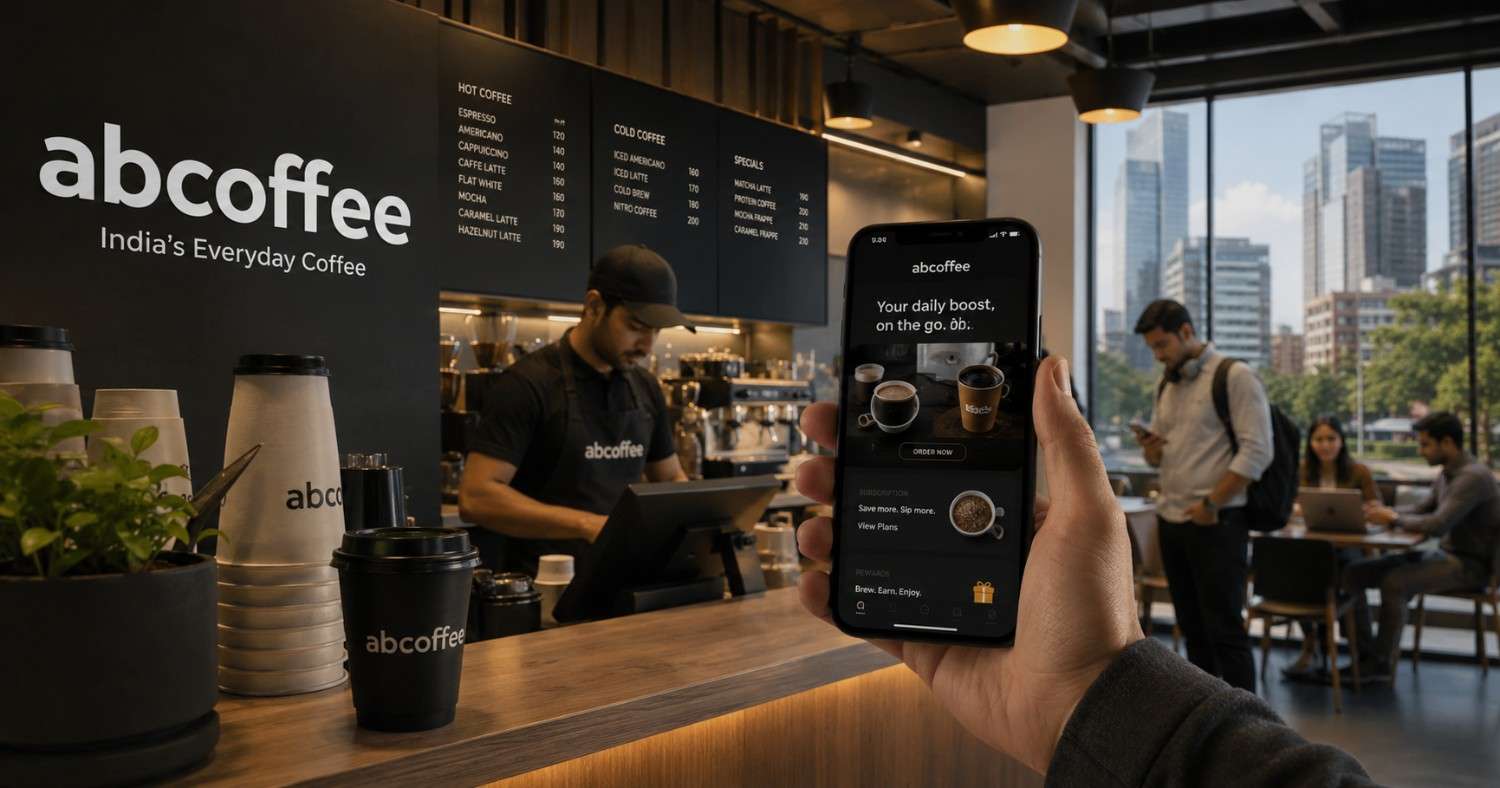
India’s organised coffee retail market is entering a new competitive phase — one increasingly shaped not by sprawling cafés and long customer dwell times, but by speed, convenience, repeat consumption, and technology-led customer engagement.
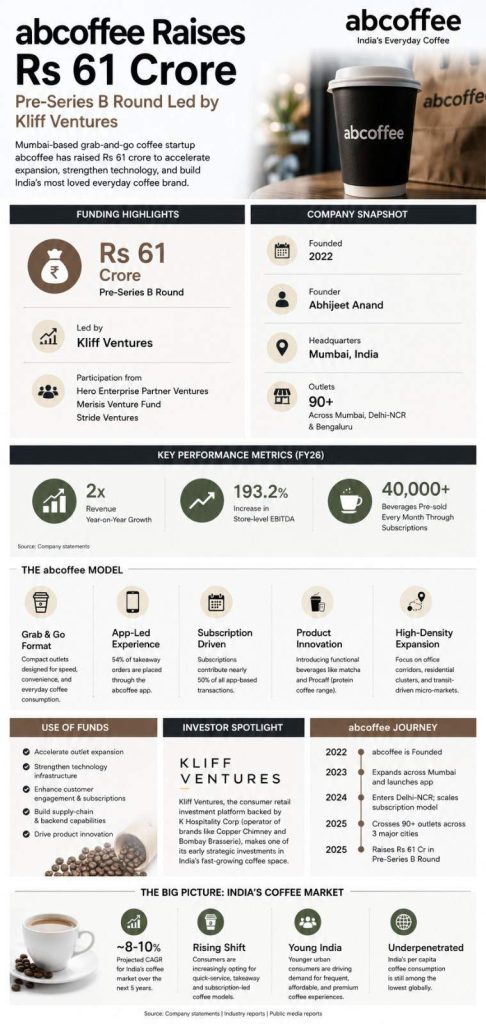
Mumbai-based coffee startup abcoffee has raised Rs 61 crore in a Pre-Series B funding round led by Kliff Ventures, according to company statements released on Monday. Existing and new investors including Hero Enterprise Partner Ventures, Merisis Venture Fund, and Stride Ventures also participated in the round.
The funding comes at a time when India’s coffee consumption ecosystem is undergoing structural change. Younger urban consumers are increasingly shifting toward smaller-format, high-frequency coffee purchases, creating opportunities for startups that position themselves differently from traditional café chains.
Founded in 2022 by Abhijeet Anand, abcoffee operates a grab-and-go coffee model focused on compact retail formats, app-led ordering, subscription-driven consumption, and quick service. The company currently runs more than 90 outlets across Mumbai, Delhi-NCR, and Bengaluru.
A Different Bet on India’s Coffee Opportunity
For years, India’s organised café industry was dominated by experience-led formats pioneered by brands such as Cafe Coffee Day and Starbucks. These businesses largely depended on customers spending time inside stores, combining beverages with food and social interaction.
abcoffee is attempting to build a different consumption habit.
Its business model revolves around what the industry often calls “habit coffee” — frequent, everyday purchases integrated into office commutes, transit movement, and urban routines rather than occasional café visits.
This strategy mirrors broader global trends visible in Asian coffee markets where convenience-first chains have scaled rapidly through dense store networks, lower operating footprints, and mobile-led ordering systems.
According to the company, 54% of takeaway orders are now placed through its app, while subscriptions contribute nearly half of all app-based transactions. abcoffee also claims to pre-sell more than 40,000 beverages every month through subscription and prepaid consumption models.
That level of recurring engagement is significant because subscription-driven purchasing can improve customer retention, predictability of revenue, and operating efficiency — particularly important in food retail businesses where margins are often under pressure.
Why Investors Are Paying Attention to Coffee Startups
The investment also reflects growing investor interest in India’s evolving coffee economy.
India has traditionally remained a tea-dominant market, but coffee consumption has steadily increased across urban centres over the past two decades. Rising disposable incomes, exposure to international café culture, food delivery platforms, and changing workplace habits have all contributed to the shift.
The organised coffee market is now becoming increasingly segmented:
- Premium artisanal coffee brands
- Large-format café chains
- Quick-service takeaway models
- Ready-to-drink and functional beverage brands
- Subscription-led digital coffee businesses
Investors appear particularly interested in startups that can combine strong unit economics with repeat daily consumption.
In abcoffee’s case, the company says its revenue doubled year-on-year in FY26, while store-level EBITDA increased 193.2% during the same period.
While the company has not publicly disclosed its absolute revenue figures or profitability status, the emphasis on store-level operating efficiency suggests that investors are prioritising disciplined expansion over pure top-line growth — a major shift from the aggressive expansion strategies that defined India’s startup ecosystem before 2022.
Kliff Ventures’ Strategic Entry Into Consumer Retail
The deal is also notable because it marks one of the early visible investments by Kliff Ventures, the newly launched consumer retail investment platform backed by K Hospitality Corp.
K Hospitality Corp operates several hospitality and food brands in India, including Copper Chimney and Bombay Brasserie.
That operational background could potentially give abcoffee access to supply-chain expertise, retail expansion capabilities, and food-service execution experience beyond pure financial capital.
Karan Kapur, Executive Director at K Hospitality Corp and Kliff Ventures, said the firm believes abcoffee could emerge as a leading player in India’s fast-growing coffee category.
The strategic alignment is important because food-service startups often struggle not only with customer acquisition costs but also with backend operational complexity — including sourcing, real estate optimisation, logistics, staffing, and consistency across outlets.
Expansion Strategy Focuses on Density, Not Just Geography
Unlike earlier café expansion cycles that prioritised flagship locations and large stores, abcoffee’s strategy appears heavily focused on cluster-led density.
The company plans to deepen its presence across Mumbai, Delhi-NCR, and Bengaluru while entering high-density office corridors, residential clusters, and transit-driven micro-markets.
This matters because coffee consumption businesses typically benefit from proximity and repeat accessibility. Dense retail clustering can improve delivery efficiency, brand recall, and operational leverage.
Industry observers increasingly view such models as more scalable in India’s urban environments where rental economics remain challenging for traditional café formats.
The company also plans to deploy capital toward:
- Technology infrastructure
- Customer engagement systems
- Subscription ecosystems
- Supply-chain strengthening
- Backend operational capabilities
- Product innovation initiatives
The Rise of Functional and Wellness-Oriented Coffee
abcoffee’s recent launches also reflect another major trend reshaping beverage consumption globally: functional coffee.
The startup has introduced products such as matcha beverages and “Procaff,” its protein coffee range targeted at health-conscious consumers.
This positions the company within a broader consumer shift toward beverages marketed around wellness, energy, fitness, and nutrition.
Globally, functional beverages have become one of the fastest-growing categories within food and beverage retail, particularly among younger consumers seeking products that combine convenience with perceived health benefits.
In India, this category remains relatively early-stage but is gaining momentum across urban consumer segments.
Competitive Pressures Remain Intense
Despite growing investor enthusiasm, the coffee retail business remains highly competitive and operationally demanding.
India’s organised coffee market already includes established players such as Blue Tokai Coffee Roasters, Third Wave Coffee, Subko, and international incumbents including Starbucks.
Meanwhile, quick-commerce platforms and food-delivery companies are also experimenting aggressively with affordable beverage formats and rapid delivery models.
The challenge for emerging coffee startups will likely revolve around sustaining:
- Strong repeat purchase behaviour
- Store-level profitability
- Consistent quality at scale
- Real-estate efficiency
- Customer retention amid rising competition
The industry is also highly sensitive to inflation in rentals, labour, and raw material sourcing.
That makes operational discipline critical — especially for companies pursuing rapid outlet expansion.
What abcoffee’s Fundraise Signals About India’s Startup Market
The latest funding round reflects a broader shift underway in India’s startup investment ecosystem.
Investors are increasingly favouring businesses that demonstrate:
- Repeat consumption behaviour
- Clear monetisation models
- Measurable operational efficiency
- Technology integration
- Capital-efficient expansion
Consumer brands capable of embedding themselves into everyday habits are attracting renewed interest after a period where venture funding became significantly more cautious.
Coffee, because of its recurring purchase nature, offers a particularly attractive category for investors — provided startups can maintain customer loyalty and strong unit economics.
abcoffee’s performance over the next few years will likely become an important test case for whether India can support large-scale, technology-driven grab-and-go coffee networks beyond premium sit-down café formats.
The Road Ahead
India’s coffee market is still relatively underpenetrated compared with mature global consumption markets, leaving significant headroom for organised players.
But scaling in food retail remains difficult.
Success will depend less on branding alone and more on operational consistency, location intelligence, digital engagement, and the ability to turn coffee from an occasional indulgence into a daily routine purchase.
abcoffee’s latest raise suggests investors believe that shift is already underway.
Whether the company can sustain growth while balancing expansion and profitability will determine if it becomes a breakout player in India’s increasingly crowded coffee startup ecosystem.
Also Read : The Rise of Startup Roll-Ups in India: Acquiring Small Brands Instead of Building From Scratch
Last Updated on Tuesday, May 26, 2026 11:53 am by Startup Updates Team
About Author


